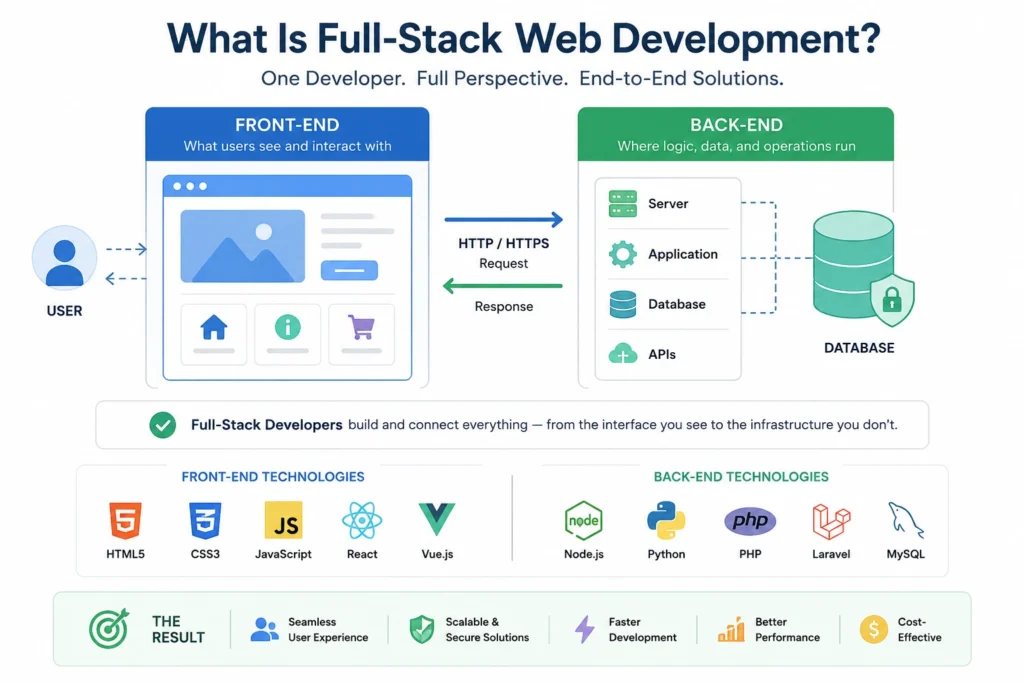
Full-stack web development covers both halves of a website or web app. There’s the front-end, the part people see and click, and the back-end, which stores the data and runs the logic underneath. One person or team handles all of it, from the button a customer taps right down to the database that records their order. That’s the short version, anyway. The longer version, the one that actually matters to your business, is the part most explainers rush past.
So here’s why you should care, in practical terms. When the front-end and back-end of your site get built by separate people who barely talk, things break in the gaps between them. A contact form that looks perfect and never actually delivers the email. A checkout that crawls because nobody owned the handoff between the design and the server. Full-stack closes those gaps, because one team owns both sides and there’s no seam to fall through. For a startup, a law firm, or a store that’s growing faster than its website can keep up, that tends to mean a site built quicker, for less money, with fewer nasty surprises.
We’ll get into what the front-end and back-end really are, what a full-stack developer actually does all day, and when this approach fits your project. Also when it doesn’t, because it isn’t always the answer.
What Full-Stack Web Development Actually Mean?
Full stack web development means building and maintaining every layer of a web application, the part users touch, the server logic behind it, and the database holding everything together. Put a full-stack team on a project and they can carry it from a blank page to a live, working product without handing it off three times along the way. You’ll also see it written as full stack web development, or just fullstack; the hyphen moves around, but the idea holds. Full-stack development is the process of owning all of it, front to back.
Or, stripped of the jargon entirely: full-stack web development explained is just one team that can build your whole website, front to back, instead of parceling out slices to people who each only see their own corner.
The word “stack” trips people up more than it should. It’s only the set of technologies stacked together to run a site. Picture three layers. The front-end sits on top, everything you see in the browser. The back-end runs underneath it, where the logic happens and decisions get made. And the database sits at the bottom, holding all the information. Full-stack covers all three, plus the wiring between them and the job of actually getting the thing live on the internet. In other words, full-stack development combines every part of the development process under one roof, from the first line of front-end code to the last database migration. Honestly, most guides make this sound more complicated than it is. Strip it down and it’s one idea: a person, or a team, who understands the whole system instead of one slice of it. The specific programming language or application framework they reach for matters far less than that complete understanding.
Front-End vs Back-End, What Is The Difference?
The front-end is what users see and interact with in their browser. The back-end is the server, the logic, and the data they never lay eyes on. Think storefront versus the warehouse and the staff working behind the wall.
This front-end vs back-end split is really the heart of the whole thing, so let’s get it clear. The front-end, or client side if you want the technical name, gets built with HTML, CSS, and JavaScript, usually with a framework like React or Vue.js layered on top. Those three, HTML for structure, CSS for styling, JavaScript for behavior, are the front-end technologies every web developer starts with. It’s everything visual. The layout, the colors, the buttons, the form fields, the way a menu slides open when you tap it on your phone. It overlaps with web design, though design decides how things look and front-end code makes them actually work in the browser. The front-end is really the client software your visitor runs without realizing it, the web pages rendering on their screen. Basically, if you can see it or touch it, you’re looking at the front-end, and clean HTML and CSS are what make it feel right.
The back-end is the opposite. You never look at it directly, yet you lean on it constantly. It runs on languages like Node.js, Python, PHP, or Ruby, and it does the unglamorous heavy lifting: checking a password, running a payment, saving an order, firing off a confirmation email. That’s the business logic, the rules that decide what actually happens. It lives on a web server, talks to a database, and handles the database management most users never think about. Log into an account and the front-end collects what you typed while the back-end quietly decides whether it’s right. This is back-end development, the server software side of the house, and it’s every bit as much craft as the visible part. One is useless without the other, which is the part people miss. A gorgeous site with a broken back-end just frustrates everyone. And a powerful back-end wearing an ugly, confusing front-end loses people before they ever get to the good part.
What Does A Full-Stack Developer Do?
A full-stack developer builds and connects both the front-end and the back-end of a web project, database included. They can carry a single feature from its visual design all the way through to the server code and the data that make it actually work.
So picture a normal day. They might spend the morning fussing over how a page looks and behaves in the browser, then switch gears after lunch to write the server code that saves whatever a user just submitted. That range is the point. Because they understand both sides, they make sharper calls about how the two connect, and that connection is exactly where a surprising number of projects quietly fall apart. Hand a full-stack developer a product idea and they can build the whole thing, interface, logic, data storage, and the deployment that puts it online. Roughly, here’s what that covers:
- The front-end work. This is front-end development in practice: turning a design into a real, responsive interface that holds up on phones, tablets, and desktops, handling all the user interactions, and keeping a careful eye on speed and accessibility.
- The back-end work. The back-end web development side, writing the server logic, building the APIs that let front-end and back-end talk to each other, and wiring up the database so information saves and loads the way it should.
- The connective work. This is the part that ties it together. Making the two halves communicate cleanly, handling security, and setting up deployment and hosting so the thing actually runs out in the real world rather than only on a laptop.
Now, not every full-stack developer is equally deep in every layer, and nobody expects them to be. Most lean a bit stronger toward either the front or the back while still working comfortably across the whole thing. Seeing the full picture is what counts.
Why Businesses Choose Full-Stack Development Services
Businesses go full-stack because one team owning the whole build beats stitching together separate specialists, faster, cheaper, less to coordinate. For most small and mid-size projects, that end-to-end ownership pretty much is the advantage.
Think about the alternative. Hire a front-end specialist, a separate back-end engineer, maybe a database person, and now you are the one translating between three people who each see only their piece. Something always falls in the gap. With full-stack development services, one team carries the project from start to finish, so there is a single point of accountability and far less lost in translation. For a startup watching its budget, this matters enormously, since a small full-stack team can get a site or app running at a fraction of the cost of a larger, more specialized one. It is also faster, because the person building your interface already understands the server it talks to. You are not paying for meetings between two vendors who keep blaming each other.
There is a limit to this, and we will be honest about it. A massive, complex platform with millions of users usually needs deep specialists in each layer, not generalists. But most businesses are not building that. They are building a site, a web app, a customer portal, or an online store, and for those, full-stack is very often the smartest way to go.
When Full-Stack Is Not The Right Fit
Full-stack isn’t always the answer, and it’s worth saying so plainly. Very large or highly specialized projects tend to need dedicated experts in each layer, and a lone generalist can turn into a bottleneck instead of a help.
I want to be straight about this, because plenty of agencies will sell you full-stack for everything. If you are building something enormous, a platform handling huge traffic, complex real-time features, or serious security and compliance demands, you probably want specialists who live and breathe one layer. A full-stack generalist stretched across all of it can slow things down or miss depth in the area that matters most. The honest rule is simple. For most small and mid-size business projects, full-stack ownership wins on speed and cost. For the rare project at real size and complexity, specialists earn their keep. A good partner tells you which camp you are in before taking the work.
The Common Technology Stacks, Briefly
Most full-stack projects run on one of a few well-known combinations of technologies, usually referred to by acronyms. You don’t need to memorize any of this, but recognizing the popular stacks helps when a developer walks you through their approach. These are just the popular technology stacks, the sets of languages and technologies that tend to go together.
- The MERN stack. MongoDB, Express.js, React, and Node.js, all built around JavaScript, which is why teams love it when they want one language across the entire stack. MongoDB handles the database, Express.js and Node.js run the server-side programming, and React builds the front-end technologies you see. Fast to work in, and a common pick for complete web applications.
- The MEAN stack. Nearly the same idea, but it swaps React for Angular. Same JavaScript-everywhere logic, different front-end framework.
- The LAMP stack. Linux, Apache, MySQL, and PHP, the older, reliable combination still running a huge share of the web, WordPress included. Not flashy, but it works, and there’s a deep pool of software developers who know it.
- Python and Ruby options. A lot of well-known products run on Python with the Django framework, or on Ruby with Ruby on Rails. Both are open-source, mature, and well-documented, which makes them safe bets when you want a foundation that won’t surprise you. Java development and PostgreSQL show up plenty here too, especially on larger builds.
- Cloud and the modern extras. More and more, parts of the build lean on cloud computing platforms like AWS for compute and hosting, with services like Elastic Beanstalk handling deployment and high availability so the site stays up under load. DevOps practices like continuous integration ship changes safely, and behind the scenes the pieces pass data around as JSON while routine chores like database migrations keep the data layer in sync. A small team leaning on these moves faster than a bigger one did a few years back.
Which stack is right matters less than whether it fits your project and where you’re headed. A good full-stack team picks the one that serves your goals, not the one they happen to enjoy, and they’ll explain the tradeoff without hiding behind jargon.
How AI Is Changing Full-Stack Work In 2026
AI has genuinely shifted how full-stack teams work, mostly by speeding up the routine coding. It writes boilerplate, suggests fixes, and drafts tests, which frees a developer to focus on the harder architecture calls that AI still can’t make well.
Let me be measured about this, because there’s a lot of noise. AI coding tools are real and useful. A developer using them can move through the repetitive parts of a build faster, scaffolding a component, wiring up an API, cleaning up a script, so the human hours go to the decisions that actually need judgment. Whether the work is frontend or backend, the same holds: tools written in NodeJS and every other language can now draft a first pass in seconds. But AI hasn’t replaced the developer, and honestly it isn’t close. Someone still has to decide how the pieces fit, whether the data model makes sense, and where a shortcut will cost you later. What AI has done is raise what a small full-stack team can ship. A two-person shop in 2026, leaning on AI for the grunt work and cloud computing for the infrastructure, can build things that took a much bigger team not long ago. That’s the real story here, not that AI writes the code, but that it makes good developers faster. The judgment is still the job.
What To Look For In A Full-Stack Team
The best full-stack teams are judged less by the technologies they list and more by how they think about your whole project. You want people who ask about your goals before they talk about their tools.
A few things separate a strong full-stack partner from a weak one. Look for a portfolio that shows finished, working products rather than only pretty mockups, since anyone can design a screen but far fewer can ship the working system behind it. Ask how they handle the handoff between design and code, because that seam is exactly where full-stack is supposed to help and where a pretender will fumble. Pay attention to how they explain things, too. A team that can describe front-end vs back-end tradeoffs in language you understand is a team that will keep you informed through the build, rather than hiding behind jargon when something slips. And ask who owns the project end to end. If the answer is “well, it depends,” you are back to coordinating specialists yourself, which is the exact problem full-stack was meant to solve.
Frequently Asked Questions
What is full-stack web development in simple terms?
It’s building both halves of a web app: the front-end that users see and click, and the back-end, the server and database, that they never do. One full-stack developer or a small team can build the whole thing end to end, from the interface down to data storage and deployment. No handoffs between three different vendors.
What does a full-stack developer do?
Plenty, honestly. A full-stack developer works across both the client-side and the server-side of an app. They build the user interface, write the server logic and APIs, manage the database, and handle deployment. The upshot is that one person, or a small team, can take a project from a rough concept all the way to a live, working product.
What is the difference between front-end and back-end?
The front-end is everything users see and interact with in the browser, built with HTML, CSS, and JavaScript. The back-end is the server-side logic and the database sitting behind it, the stuff users never see directly, built with languages like Node.js, Python, or PHP. Short version: front-end handles how it looks, back-end handles what it does.
Is full-stack development cheaper than hiring separate developers?
For small and mid-size projects, usually yes. When one full-stack team owns the whole build, you cut the coordination costs, the communication gaps, and the duplicated effort that come with juggling separate specialists. That’s why so many startups and small businesses land on full-stack development services instead of assembling a roster of individual experts.
Do I need a full-stack developer for my website?
For most business websites, web apps, and online stores, yes, a full-stack approach fits well, since one team can handle the whole build without much friction. The exception is the big, highly specialized platform, which often does better with dedicated front-end and back-end experts instead.
How is full-stack development different from front-end or back-end alone?
Full stack development explained simply: it combines both. A front-end developer handles what you see, a back-end developer handles the server and data, and a full-stack developer works across the entire application development lifecycle. It takes years to become a full-stack developer with real depth on both sides, which is exactly why that end-to-end view is valuable.
Ready To Build Your Site The Right Way, End To End?
If you have ever had a project stall because your designer and your developer were not speaking the same language, you already understand the problem full-stack solves.
At DesignFxPro, we handle both sides of your build, the front-end your customers see and the back-end that makes it work, so nothing falls through the cracks between two vendors. Whether you need a marketing site, a web app, or an online store, we own the whole thing and keep you talking to one team, not three.
Book a free consultation with DesignFxPro. Tell us what you want to build, and we’ll show you how a full-stack approach can get it done faster, cleaner, and with far fewer headaches than piecing it together yourself.