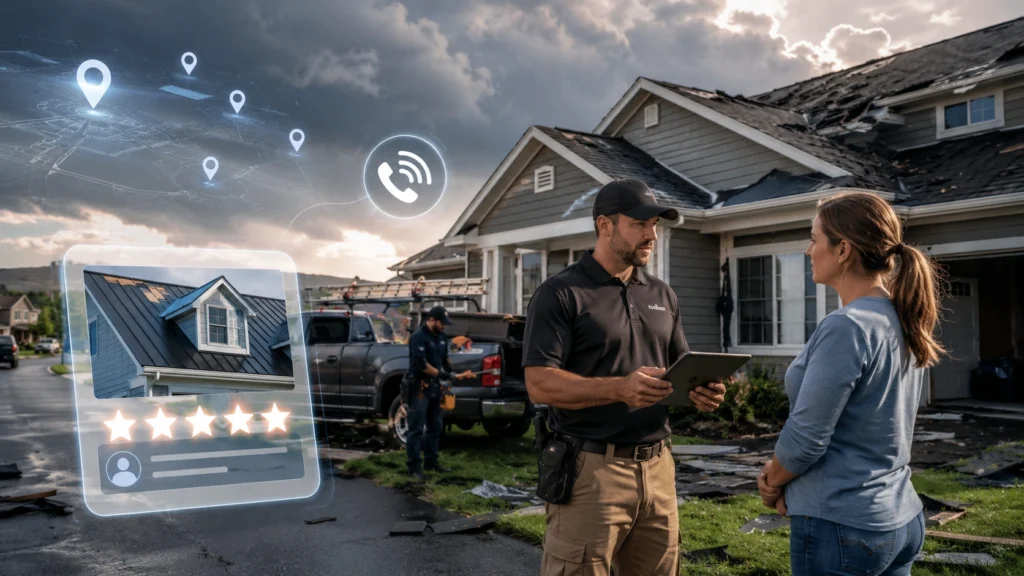
You get storm damage roofing leads by knowing exactly which streets got hit, showing up there before anyone else, and being the roofer homeowners trust when three others knock the same day. That is the whole thing compressed into a sentence. Storm work rewards speed and preparation in a way normal roofing does not, because the demand appears overnight and disappears in a few weeks.
Here is the uncomfortable truth most guides skip. The roofers who book the most work after a hailstorm mostly won it before the storm ever formed. Their Google profile was already strong, their reviews were already flowing, their crews were already scheduled. When 12 million American homes took hail damage in a single recent year, the contractors who booked those jobs were not scrambling to build a web presence in the 48 hours after. They were already visible, and they just turned up the volume.
So this post covers both halves. What to do in the hours and days after a storm hits, and what to build in the quiet months so you are ready when it does.
Why Storm Work Is Different From Normal Roofing
Storm work compresses a year of demand into a few weeks, involves insurance claims instead of simple quotes, and puts you against out-of-town competitors who arrive within hours. Everything moves faster and the margins are bigger.
Think about how different the customer is. A homeowner replacing a worn roof has been thinking about it for months and is comparing three quotes at their leisure. A homeowner whose roof just took golf-ball hail is anxious, confused about their insurance, and being knocked on by strangers. They are not shopping carefully; they are looking for someone credible to tell them what just happened to their house. That emotional difference changes everything about how you win the work. And the money is real, since roof replacements make up roughly 70% of residential storm damage claims, and a typical asphalt shingle replacement runs $5,000 to $10,000 or more. Storm season is where a lot of roofing companies earn the bulk of their annual revenue.
How Do You Find the Neighborhoods That Got Hit?
Use storm-tracking data rather than guesswork. Platforms like HailTrace and Interactive Hail Maps, plus NOAA storm reports, overlay verified hail and wind paths on maps so you can target the specific streets that took the worst impact.
Watching the weather channel and driving around is how contractors did this twenty years ago, and it wastes most of your effort. Modern storm data shows you hail swaths down to the neighborhood, including stone size, which matters because pea-sized hail rarely does functional damage while anything golf-ball or larger usually does. Focus your crews on the hardest-hit zones and skip the streets that caught the edge. Every hour spent canvassing a block that took minor hail is an hour not spent where the real claims are. Some contractors overlay this data in a canvassing CRM so their teams see the same map and do not double-knock the same houses. The point is precision. Storm response comes down to speed, and the roofers who target well simply cover more real damage per crew per day.
What Should You Do in the First 24 Hours?
Move immediately. The first 24 hours after a storm decide most of the work, because homeowners hire whoever gets to them first with a credible answer, and they are hearing from several roofers that same day.
Speed is the entire advantage in storm work, more than in any other kind of roofing. Here is what the fastest companies actually do:
- Dispatch to the hardest-hit zones same day. Not tomorrow. Teams already in the neighborhood while homeowners are still standing in their yards looking at the mess have an enormous edge over anyone arriving on day three.
- Document damage with real photos. Insurance adjusters have gotten stricter, so a clear high-resolution photo of a hail-struck shingle closes far more deals than telling someone their roof looks bad. Photos also become the homeowner’s claim evidence, which makes you useful immediately.
- Turn on hyper-local ads. Run tightly geo-targeted ads within a few miles of the damage path so your name appears while homeowners are searching. Google Local Services Ads work well here, and the Google Guaranteed badge signals you are vetted, which matters a lot in a week full of strangers knocking.
- Get your office ready to answer. Storm weeks generate call volume that will bury a normal front desk. Missed calls in the first days are lost jobs, since a homeowner who cannot reach you simply calls the next roofer.
None of that is complicated, but all of it depends on being organized before the storm rather than improvising after.
How Does Insurance Knowledge Win You Jobs?
Homeowners are more confused about the claims process than about roofing, so the contractor who explains it clearly wins their trust. Knowing deductibles, adjuster meetings, and filing deadlines makes you the guide instead of another salesperson.
This is where I would put most of your training effort, honestly. After a storm, the questions flooding roofing offices are almost never about shingle brands. They are things like whether to call the roofer or the insurer first, what hail size actually counts as damage, and how to avoid getting a claim denied. Most policies require filing within six to twelve months of the storm, and insurers respond more favorably when the inspection happens soon after the event, which is genuinely useful information a homeowner will thank you for. When you can sit down with a homeowner and walk them through what happens next, calmly and without pressure, you stop being a stranger at the door and become the person handling their problem. That trust is what converts after storm roofing jobs at a much higher rate than a hard pitch ever will.
How Do You Beat the Storm Chasers?
Beat them on trust and permanence. Out-of-town crews arrive fast but have no local reviews, no local address, and no reason for a homeowner to believe they will honor a warranty next year. Lead with what they cannot fake.
Storm chasers are the real competition, and homeowners are wary of them for good reason. Your advantages are boring and powerful. You have a local address, a review profile built over years, neighbors who can vouch for you, and you will still exist when the warranty matters. Say that plainly. The Google Guaranteed badge on Local Services Ads helps here too, since it requires a background check, which quietly separates you from the truck with out-of-state plates. Homeowners who just watched their roof get destroyed are afraid of being taken advantage of, and reassurance about permanence lands harder than any discount. This is also why the roofers with strong local visibility win storm seasons repeatedly while the ones who only show up after storms have to build credibility from scratch every time.
What Should You Build Before Storm Season?
Build the visibility that cannot be created in a hurry: local search rankings, a steady review profile, and content about storm damage and insurance claims. These take months to develop and pay off in a single week.
Here is the part that separates roofers who consistently profit from storms from those who occasionally get lucky. Local SEO and community presence cannot be assembled in the days after a hailstorm; if you do not have them when the storm hits, your next real chance is the storm after that. So use your slow months on the things that take time to mature:
- Rank locally before you need to. Claim and fully build your Google Business Profile, and make sure it stays active. When strangers with out-of-state plates are knocking, being the established name in the map pack is worth more than any pitch.
- Publish storm and insurance content. Pages explaining hail damage inspections, what insurers cover, and how claims work will rank quietly for months, then bring you storm damage roofing leads the week homeowners start searching.
- Gather reviews year-round. Not in a burst after a storm. A profile with steady recent reviews is exactly what an anxious homeowner checks before letting anyone on their roof.
- Line up capacity in advance. Know which crews and suppliers you can scale to before you need them, because winning the leads and then failing to schedule the work just hands the job back to a competitor.
Then, when the next storm lands, all that quiet work turns into hail damage roofing leads arriving through search while your competitors are still printing door hangers. Roofing storm marketing looks like a speed contest, but most of it is preparation done months earlier.
Not Every Storm Lead Is Worth Chasing
Some storm inquiries will never turn into paid work, and learning to spot them early protects your margins. The best storm damage roofing leads come from verified damage zones where the homeowner has real, claimable damage and a policy that covers it.
A few things separate a real opportunity from a dead end. Damage that falls below the functional threshold, cosmetic granule loss from small hail, for instance, often will not get approved, and chasing those claims costs you days you could spend on approved jobs. Homeowners outside the verified storm path sometimes call anyway, hoping for a fully covered replacement, and NOAA-based hail reports let you check quickly rather than sending a crew. Policies matter too, since some carry high wind and hail deductibles that make a modest claim not worth filing for the homeowner. None of this means turning people away rudely; an honest inspection that concludes “your roof is actually fine” builds enormous goodwill and often produces a referral later. It just means being realistic about where your crews spend storm week, because that window is short and every hour has a cost.
Frequently Asked Questions About Storm Damage Roofing Leads
How do roofing companies get storm damage leads?
They combine storm-tracking data to identify hardest-hit neighborhoods, immediate canvassing and documentation within the first 24 hours, hyper-local ads targeting the damage path, and existing local search visibility. Contractors with established Google profiles and reviews before the storm capture significantly more of the work.
What size hail causes roof damage?
Hail around one inch, roughly golf-ball size, or larger typically causes functional roof damage that insurance will cover. Smaller hail often strips protective granules without causing immediate failure, which is why professional inspection and photo documentation matter for claims.
How long do homeowners have to file a storm damage claim?
Most insurance policies require filing within six to twelve months of the storm date, though exact windows vary by policy and state. Insurers generally respond more favorably to claims where inspection and documentation happened soon after the storm event.
Are storm damage roofing leads worth buying?
Purchased storm leads are usually shared with several contractors and cost more per job than leads you generate yourself. Building your own storm roofing leads through local search visibility, reviews, and fast response produces better margins and repeat referrals.
How much is a typical storm damage roofing job worth?
A typical asphalt shingle roof replacement runs about $5,000 to $10,000, with larger or specialty roofs costing more. Roof replacements account for roughly 70% of residential storm damage claims, making storm work among the highest-value jobs in residential roofing.
Ready To Be the Roofer Homeowners Call After the Next Storm?
If the last hailstorm filled your competitor’s schedule while your phone stayed quiet, the difference usually was not luck. It was visibility built months earlier.
At DesignFxPro, we get roofing companies ready before the weather turns, with local search visibility, a strong review profile, storm and insurance content that ranks, and ad campaigns we can switch on the moment a storm lands in your service area. It is one piece of the bigger picture we cover in our approach to roofing marketing, where local search, reviews, and your website work together to keep the calendar full year-round.
Book a free consultation with DesignFxPro. We’ll show you where your storm readiness stands today, what to build before the next season, and how to capture more storm damage roofing leads when it counts.