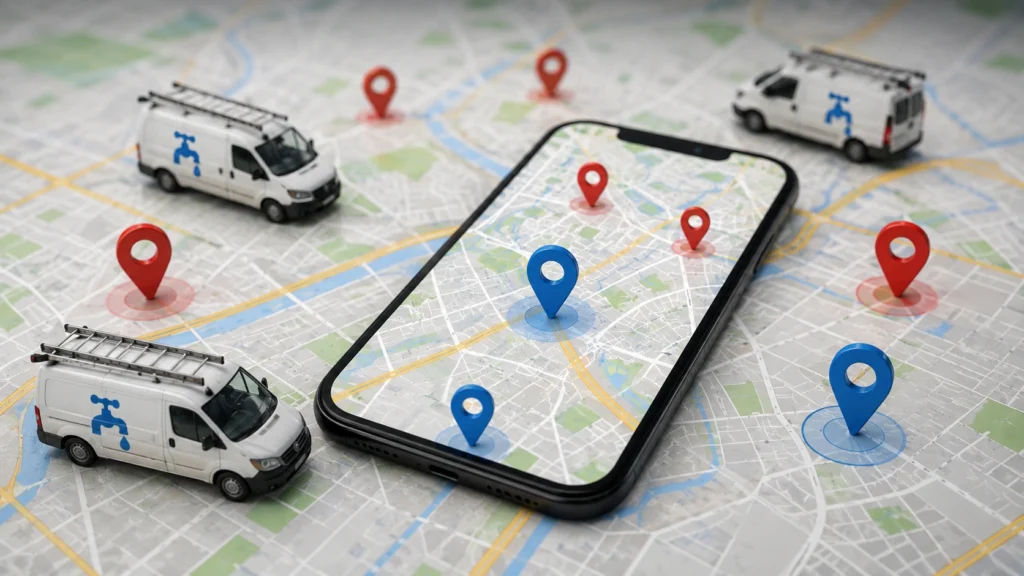
Your plumbing Google Maps position is not one number, it is a map. A plumbing company can sit at position one when the search comes from its own address and fall to position seven or eight just five miles away in the next postcode, and both of those are true at the same time. Proximity is a ranking factor, so your visibility changes block by block across the area you serve.
This is the single most confusing thing owners run into with Maps. You check your ranking from the office, see yourself at the top, and cannot understand why the phone is quiet. Meanwhile a homeowner four suburbs over searches the same term and never sees you at all. Nothing is broken. You are simply measuring one point on a surface that varies everywhere.
So this post covers why a single ranking check misleads you, what actually decides Maps position, how to measure your real coverage, and how to widen the area where you win.
Why One Ranking Number Tells You Almost Nothing
Ask most local businesses where they rank and they will quote one position from one search on one phone, usually at their own premises. That figure is close to meaningless, because local rank changes continuously across a service area.
Think about what that check actually measured. You searched from the place where your proximity signal is strongest, which is the one location where you were always going to look good. It tells you nothing about the neighbourhood where you would like more work, or the suburb where your best-paying jobs come from, or the town where a competitor quietly owns every search for “plumber near me” and “emergency plumber.”
This matters commercially rather than academically. Around 42% of local search clicks go to the map pack, the 3-pack of businesses sitting above everything else, and for plumbing that share is higher still because so many searches are urgent. Someone typing “plumbing near me” at ten at night is choosing from three listings, and which three depends entirely on where they are standing. They will call the first plumber that looks credible, usually the one with the most 5-star feedback on their review page. If you are invisible on Google across two thirds of your coverage area, you are missing most of that local search traffic while a dashboard reassures you that you rank third. That gap between your reported plumbing Google Maps position and where you actually get found is where the lost work hides.
How Does Google Decide Who Shows on the Map?
Three signals: relevance, proximity, and prominence. How well you match the search, how close you are to the searcher, and how established your business appears. Google uses the same three to rank local businesses in every category, and you can move two of them but not the third.
Relevance is your categories, services, and the language on your profile and site. It is why a listing naming water heater replacement, drain cleaning, and sewer line work specifically will surface in more Google Maps results than one describing itself only as a plumber. Each of those is a separate keyword someone types, and a profile that mentions none of them is relying on Google to guess. This is the part of SEO for plumbing companies that costs nothing beyond the time to fill it in properly, and it is where you can optimize fastest. Prominence is your reviews, citations, links, and general reputation. Both are workable, and most businesses can shift them meaningfully inside sixty to ninety days. Proximity is fixed, because you cannot move your building closer to every homeowner in the county.
That constraint sounds discouraging until you see what follows from it. Since distance is the one ranking factor you cannot change, the sensible goal is not a better single position. It is expanding the geographic area where you already rank, and that expansion is driven almost entirely by prominence. For a home service business without a storefront, prominence is what decides whether your visibility reaches beyond your immediate surroundings. This applies equally to HVAC companies, electricians, and anyone else dispatching vans, though plumbing feels it most sharply because so much of the work is urgent. Setting a 20-mile radius in your profile does not make local rankings appear across those twenty miles; it only tells Google you are willing to drive there.
Does Hiding Your Address Hurt Your Rankings?
Hiding your address is correct for a plumbing company that travels to customers, and it does not remove proximity from the equation. Google still knows roughly where you are and still weights distance accordingly.
This trips up a lot of owners who assume that setting a wide service area in their plumbing Google Business Profile tells Google to treat them equally everywhere inside it. It does not. Service areas describe where you are willing to work; they are not a claim on where you rank in plumbing Google Maps results. Google continues to favour businesses physically near the searcher, and it will usually show a plumber with premises in that neighbourhood ahead of one covering the whole county from twelve miles away.
There is an uncomfortable conclusion worth stating plainly, because most agencies will not. If you want to rank in a neighbouring town where established competitors are based, doing it without any physical presence there is genuinely difficult. Prominence can narrow the gap and sometimes close it, but proximity is a strong signal that frequently outweighs both experience and review count. This is why some growing plumbing companies eventually open a second location rather than trying to stretch one listing across a metro area.
How To Measure Where You Actually Rank
Use a geo-grid scan, which runs the same search from dozens of coordinates across your service area and returns a heat map instead of a single number. Twenty-five to forty-nine points is the normal range.
Grid spacing depends on your territory, and getting it wrong wastes the exercise:
- Dense urban areas, roughly a one-mile grid. Rankings shift quickly where businesses are packed together, so tight spacing shows you the real picture.
- Suburban or rural coverage, three to five miles between points. Wider spacing keeps the scan meaningful without drowning you in data you will never act on.
- Tools that automate it. Local Falcon, BrightLocal’s grid, and similar tools run in minutes and track competitors alongside you. Worth the cost once you are actively working on this.
- The free version, if budget is tight. Pick ten to fifteen locations across your area, major intersections and neighbourhood centres, then search your main term from each in an incognito window with the location set manually. It takes two or three hours per keyword and it works.
The number worth tracking from all this is the share of grid points where you appear in the top three. On a seven by seven grid of forty-nine points, ranking top three at twelve of them is roughly 25% coverage. That single figure tells you far more than any individual position, and watching it climb quarter by quarter is how you know the work is landing.
One nuance most people miss. The results inside the Maps app and the three-pack that appears in ordinary search results are two separate surfaces, and you can rank differently on each. If you are tracking only one, you are seeing half the picture.
How Do You Expand the Area Where You Rank?
Build prominence, since it is the signal that carries your visibility outward from your address. Reviews, consistent business information, genuine local content, and steady profile activity all widen the area where you can compete.
The work here is cumulative rather than clever:
- Reviews, continuously. The strongest prominence signal available to a plumbing company, and the one most within your control. Automate your review requests so they go out after every completed job rather than whenever someone remembers, since steady velocity of new reviews matters as much as the total. Encourage customers to describe the actual problem you solved, a burst pipe, a water heater replacement, since that language reinforces relevance naturally.
- Consistent business details everywhere. Your name, address, and phone number matching exactly across every directory and citation. Inconsistency quietly undermines trust and it is tedious rather than difficult to fix.
- Real location pages on your site. These do not change distance, but they support relevance and discovery, and they help Google associate your business with the places you serve. Adding LocalBusiness schema markup to them gives search engines structured confirmation of who and where you are.
- A profile that looks alive. Regular posts and photos will not directly lift your position, though they help conversions and can settle ties between similar competitors nearby.
That last point is worth being honest about, because plenty of guides overstate it. Posting three times a week will not push you up the map. It makes the listing more persuasive to the people who already see it, which is a different and still worthwhile thing.
What If a Target Suburb Is Simply Out of Reach?
Sometimes it is, at least through the map. When established competitors are physically based in a suburb you want, matching them on proximity is impossible, so the honest options are a second location, or reaching those customers through channels where distance does not apply.
I would rather say this than sell you a year of work that cannot deliver. If three well-reviewed plumbers operate out of a town twenty minutes away and you are trying to compete there from outside, no amount of profile tidying overcomes the distance signal on its own. Prominence narrows the gap and occasionally wins, particularly if those competitors have neglected their listings, but it is not a reliable plan. Before committing budget to a town like that, run the grid and see how far your current coverage actually reaches; sometimes the honest answer is that the suburb next door is a better target and nobody had checked.
The practical alternatives are worth knowing. Google Ads and Local Services Ads let you appear in areas where your plumbing Google Maps presence cannot reach, because you are buying placement rather than earning proximity, and they rank faster than anything organic will. Service pages and location content can rank in ordinary search results for that town even when the map pack stays closed to you, which still brings plumbing work through the door. And if the area genuinely produces enough demand to justify it, a real second location with staff and hours changes the calculation entirely. That is a business decision rather than a marketing one, which is exactly why it should be made with real coverage data in front of you rather than a hunch.
Do Directories Like Angi and Yelp Affect Your Map Ranking?
Indirectly, yes. Listings on Angi, Yelp, HomeAdvisor, and similar sites act as citations, and consistent business details across them feed the prominence signal that widens your coverage. They matter for local SEO even if you never buy a lead from them.
This surprises owners who have written those platforms off as expensive lead sellers. The lead-buying side and the citation side are separate things. A free, accurate Yelp listing costs nothing and reinforces to Google that your business is real, established, and located where you say it is. An Angi profile with the wrong phone number does the opposite, quietly contradicting your Google Business Profile and undermining the consistency Google is looking for.
So the practical job is a directory audit rather than a spending decision. Find every listing carrying your business name, check the phone number and address match your profile exactly, and correct or claim the ones that do not. Old listings from a previous address are the usual culprit, and they are tedious rather than difficult to clean up. Local news mentions and backlinks from local news sites help here too, since genuine local coverage is one of the stronger prominence signals available to a plumbing company.
How Does Map Visibility Feed AI Answers?
Increasingly directly. When someone asks an AI assistant for a plumber in their area, the answer is assembled partly from the same local data that powers Maps, so a complete profile with strong reviews makes you more likely to be named.
This is worth understanding because it changes what the work is worth. The profile you maintain for Maps now serves two purposes at once, feeding both the map pack and the AI summaries appearing above traditional results. Businesses with thin listings, inconsistent details, or few reviews are less likely to be surfaced in either, and the gap between the well-maintained and the neglected is widening rather than closing.
There is no separate AI strategy required, which is the reassuring part. Accurate service descriptions, complete categories, real reviews mentioning the actual work performed, and consistent details across the web serve both purposes. The same local SEO habits that improve your Maps coverage make you quotable to an AI, and neither rewards shortcuts.
Frequently Asked Questions About Plumbing Google Maps Rankings
Why does my plumbing Google Map ranking change depending on where I search?
Because proximity is a ranking factor. Google shows different results based on the searcher’s exact location, so a plumbing business can rank first at its own address and drop to seventh or eighth five miles away. Checking your rank from one place tells you very little.
Does hiding my address hurt my ranking on Google Maps?
No, and hiding it is correct for a business that travels to customers. However, hiding the address does not remove proximity as a ranking factor. Google still weighs how close you are to each searcher, so service area settings describe where you work rather than where you will rank.
How do I check my Google Maps ranking across my service area?
Run a geo-grid scan using a tool like Local Falcon or BrightLocal, which searches from twenty-five to forty-nine points across your area and returns a heat map. Manually, you can search from ten to fifteen locations in an incognito window with the location set, though that takes several hours per keyword.
What is the most important factor for ranking a plumber on Google Maps?
Relevance, proximity, and prominence together, though prominence matters most for extending visibility beyond your immediate area. Since proximity is fixed, reviews, consistent citations, and local authority are what widen the geographic area where a plumbing business can rank.
How long does it take to improve Google Maps rankings?
Most businesses can move relevance and prominence signals meaningfully within sixty to ninety days, particularly through review collection and profile completeness. Expanding coverage across a wider service area generally takes longer, since prominence accumulates gradually.
Ready To See Where You Actually Rank Across Your Service Area?
If you have only ever checked your ranking from the shop, you genuinely do not know how visible you are where your customers live. That is not a criticism, it is just how the tool works, and it is easy to fix.
At DesignFxPro, we run geo-grid scans for plumbing companies so you can see your coverage as a heat map rather than a number, then work the signals that widen it, reviews, citations, GBP completeness, and location content. Google Business Profile optimization is where most of the movement comes from, since a complete Google Business Profile outperforms a neglected one before anything clever happens. We track the share of your service area where you appear in the top three and report on that rather than a single position taken from your own doorstep. Getting your plumbing local listing right is the foundation, and the grid is how we prove it moved. It is one piece of the bigger picture we cover in our approach to plumbing marketing.
Book a free marketing audit with DesignFxPro. We’ll scan your area, show you exactly where you win and where you are invisible, and tell you honestly what it would take to rank higher across more of it. Internet marketing for plumbing companies works best when you can see the map rather than guess at it, and more plumbing calls follow from being the best plumber visible in more places, rather than only at your own address.