Maybe you want to learn it yourself. Maybe you’re a business owner who just needs a site built and you’re trying to understand what you’re actually getting into. Either way, the question is the same at the start, and it’s a fair one to feel a little lost about. There’s a mountain of advice out there, half of it contradicts the other half, and every guide swears its way is the only way. So let’s cut through it.
When you decide to start web development, the very first thing to get straight is which path you’re actually on. Are you trying to learn to build websites as a skill, maybe for a career or for your own projects? Or are you a business that needs a website and wants to understand the process well enough to make smart decisions about it? Those are two genuinely different journeys, and most guides blur them together, which is exactly why people end up confused.
This one won’t. We’ll cover both, honestly, and by the end you’ll know which path fits you and what the realistic next step looks like.
First, Get Clear On Why You Want To Start
Before any of the how, the why matters more than people give it credit for. Someone learning to code for a career has years of runway and can afford to go deep. A business owner who needs leads coming in next quarter does not. Same topic, completely different urgency, completely different right answer.
If you’re learning for yourself, the goal is skill and you’ve got time to build it. If you’re a business, the goal is a working site that brings in customers, and the fastest reliable route to that is usually not teaching yourself to code from scratch. Be honest with yourself about which camp you’re in. It saves a lot of wasted effort later. I’ve watched business owners sink three months into tutorials when hiring would’ve had them live in three weeks, and I’ve watched aspiring developers rush a client project they weren’t ready for. Knowing your why keeps you out of both ditches.
How To Learn Web Development As A Skill
So say you want to actually learn the craft, build it into something you can do well, maybe even toward a career as a web developer. Good. Here’s the path that works, stripped of the noise, because the basics of web development are simpler than the overwhelming amount of advice makes them seem.
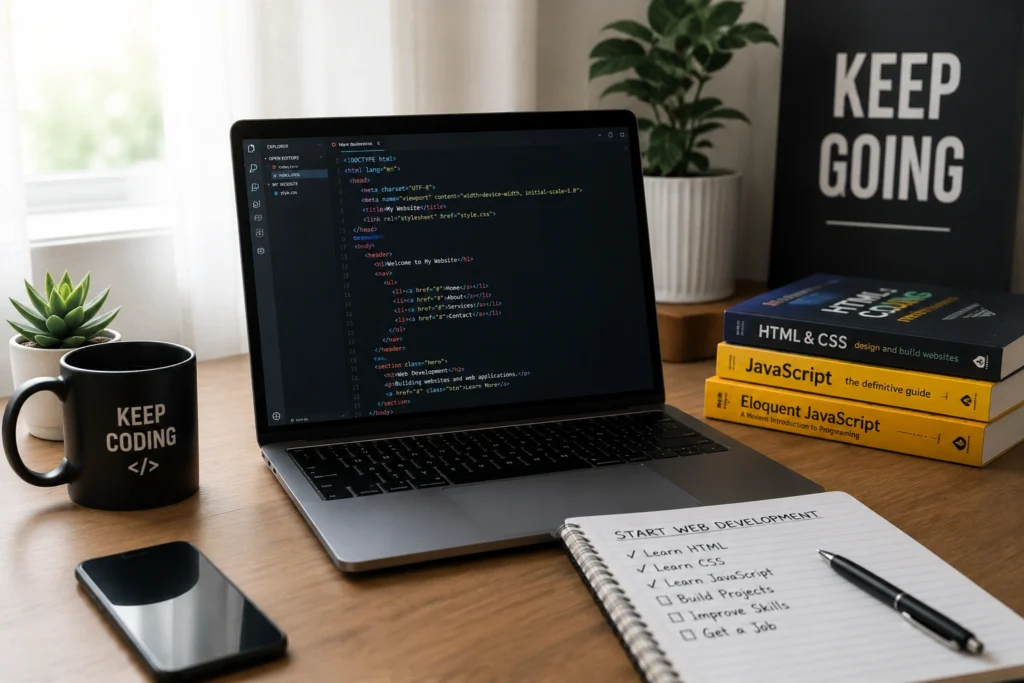
Start with the three core languages, in order. Learn HTML first, since it’s the structure of every page on the web and it’s genuinely approachable for a beginner. Then CSS, which controls how things look and how a layout adapts across different screens. HTML and CSS together get you a static page that looks right. Then JavaScript, which is where pages start doing things, reacting, updating, responding to clicks in the browser. Those three, HTML, CSS and JavaScript, are the foundation, and no framework or shortcut replaces understanding them. This is the front-end, the part a user actually sees and touches.
Once the fundamentals stick, a few things genuinely help you move from beginner to capable:
- Get the developer tools sorted early. A code editor like VS Code, your browser’s built-in developer tools for debugging, and Git for version control. GitHub is where you’ll host your source code, collaborate, and eventually show a portfolio of work to anyone hiring.
- Build real projects instead of living in tutorial hell. This one trap catches more beginners than anything else. You watch a crash course, follow along, feel productive, then realize you can’t build anything on your own. The fix is to start building. A landing page, a portfolio website, a small app that breaks and forces you to fix it. Working on projects is where the learning actually sticks.
- Add a framework after the basics, not instead of them. React is the most in-demand front-end library, Vue has a gentler learning curve, and tools like Tailwind speed up styling. TypeScript, a stricter flavor of JavaScript, tends to come later. These accelerate real work, but reaching for them before you understand plain CSS and JavaScript just hides the gaps.
- Lean on free resources. freeCodeCamp, The Odin Project, MDN, and SoloLearn are all genuinely good and cost nothing. MDN in particular is the reference the whole industry actually uses. A solid YouTube channel or two helps, but pair every tutorial with something you build yourself.
If you want to go further than the front-end, the back-end is the next layer, the server-side logic that powers what users don’t see. That means picking up a back-end language and framework, Node.js if you want to stay close to JavaScript, or Python or PHP, each beginner-friendly in its own way. You’d learn to set up a server, connect a database, and handle the functionality behind logins and forms. Pair front-end and back-end and you’re working toward full-stack, or full stack web development, which makes you far more versatile. Most people start front-end because it’s visual and gratifying, then grow into fullstack over time.
The honest timeline? A few months of consistent practice to get started in earnest, longer to get genuinely good. You don’t need a bachelor’s degree to do this, skills matter more than credentials here, and plenty of working developers are self-taught. But the learning process is real, and the people who make it are the ones who keep building projects through the parts that frustrate them.
A Rough Beginner Roadmap
If you want the learning path as a sequence rather than a pile of advice, here’s roughly how the stages stack, each one building on the last:
- Stage one, structure and style. Learn HTML and CSS until you can build a static landing page from scratch without copying. Make it responsive so it works on a phone.
- Stage two, interactivity. Add JavaScript. Make things respond to clicks, validate a form, change content without reloading. This is where web design starts becoming web development.
- Stage three, tooling. Git and GitHub for version control, plus comfort with developer tools in the browser. Get your workflow professional.
- Stage four, a framework. Pick React or Vue and rebuild something you already made, this time as a component-based interface. Add Tailwind for faster styling.- Stage five, the back-end (optional). A language like Node.js or Python, a database, and the server-side basics. Now you can deploy a full-stack web application rather than just a front-end.
Work through those in order, build a real project at each step, and you’ll have both the skills and the portfolio to start applying for jobs or taking on clients. Skipping ahead is the most common way people stall. Each module only makes sense once the one before it clicks.
How To Start Web Development For Your Business
Now the other path, and probably the more common one if you found this looking for help with your company’s site. When a business wants to web development start, the steps look nothing like the learn-to-code route. You’re not learning a skill. You’re managing a project.Here’s roughly how it goes when it goes well. You begin by getting clear on what the site actually needs to do, leads, sales, bookings, credibility, whichever. Then you sort out your content and assets, the copy, the images, the brand pieces. After that comes the build itself, whether that’s done on a platform like WordPress, custom-coded from scratch, or handed to an agency. Then testing, then you deploy it live, then the ongoing upkeep that keeps it from slowly falling apart.
The thing most business owners get wrong is thinking the build is the hard part. It usually isn’t. The planning before it and the maintenance after it are where projects succeed or quietly fail. A beautifully coded site built on a fuzzy understanding of what it’s for will underperform a plain one built with a clear goal every single time. And you don’t need to implement responsive design yourself to manage this well, you just need to understand enough to ask the right questions and recognize good work when you see it.
Should You Learn It Or Hire It Out?
This is the question under the question, and I’ll give you a straight answer rather than a diplomatic one. It comes down to time, goals, and what your hours are worth.
Learn it yourself if you genuinely want the skill, you have time to invest, or you’re a very early-stage venture where money is tighter than time. There’s real value in understanding how your own site works, and for some people the learning is the point.
Hire it out if you need results on a timeline, if your time is better spent running your actual business, or if the site needs to do something beyond the basics. Here’s the math nobody mentions: the months you’d spend learning to build a passable site is time not spent on the work that actually makes you money. For most established businesses, professional web development services pay for themselves in the time they free up alone, before you even count the better results.
There’s no shame in either choice. But pretending you’ll learn to code when what you really need is a site live by next month helps no one, least of all you.
Why This Matters For Growth
Whichever path you pick, the reason any of this is worth your attention comes back to one thing. A website is one of the highest-leverage assets a business can own, and getting the start right shapes everything that follows.
Consider what’s actually at stake. Around 75% of people judge a company’s credibility based on its website, and they form that impression in roughly 50 milliseconds. A site that loads slowly or feels dated isn’t neutral, it’s actively costing you. On the flip side, web development for business growth done properly turns your site into something that works around the clock, ranks in search, builds trust before you ever speak to someone, and captures leads while you sleep. That’s the difference between a site that exists and a site that earns.
The businesses that treat their website as an afterthought tend to get afterthought results. The ones that start web development with intention, clear goals, the right build approach, a plan for upkeep, tend to pull ahead and stay there. Where you begin matters more than it seems when you’re standing at the start of it.
A Quick Reality Check Before You Dive In
One last honest note, because the internet is full of people promising this is easier than it is. Whether you learn or hire, a good website takes real thought and real work. The tools have gotten better, AI helps, no-code platforms exist, but none of it removes the need for clarity about what you’re building and why. Keeping an eye on industry trends helps too, the stack people reach for shifts every few years, and what was standard when you started learning may not be by the time you’re building real things.
If you’re learning, expect to be confused sometimes and stuck often. That’s the process, not a sign you’re failing. Whether you’re building your first website from scratch or your tenth, the moments of being stuck never fully disappear, you just get faster at working through them. If you’re hiring, expect to be involved, the best results come from clients who engage rather than vanish until launch day. Either way, going in with realistic expectations is half the battle won.
Let’s Figure Out The Right Start For You
If you’ve read this far and landed on the hire-it-out side, or you’re just not sure which path fits, that’s worth a conversation. No pressure, no pitch.
At DesignFxPro, we offer full web development services for businesses that want their site built right the first time, law firms, clinics, e-commerce brands, and service companies. We start every project by understanding what you actually need before we recommend anything, because the right approach for a startup isn’t the right approach for an established firm.
Book a free consultation with DesignFxPro. We’ll talk through your goals honestly and help you figure out the smartest way to begin, whether that ends up being with us or not.
Frequently Asked Questions About Starting Web Development
How do I start web development as a beginner?
Start by learning the three core languages in order: HTML for structure, CSS for styling, and JavaScript for interactivity. Practice by building small real projects, use free resources like freeCodeCamp or The Odin Project, and add a framework like React once the fundamentals are solid. Consistent practice over a few months is what builds real skill.
Can I learn web development on my own without a degree?
Yes. Web development is one of the most accessible tech skills, and most working developers are partly or fully self-taught. Skills and a portfolio of real projects matter far more than a formal degree, and free online resources are enough to begin.
How long does it take to start web development?
Reaching a functional level takes a few months of consistent practice, while becoming genuinely skilled takes longer. For a business that needs a website rather than the skill, hiring a professional team can have a site live in a few weeks instead.
Should a business owner learn web development or hire a developer?
A business owner should usually hire web development services rather than learn to code, because the time spent learning is time taken away from running the business. Learning makes sense only if you want the skill itself or you’re a very early-stage venture with more time than budget.