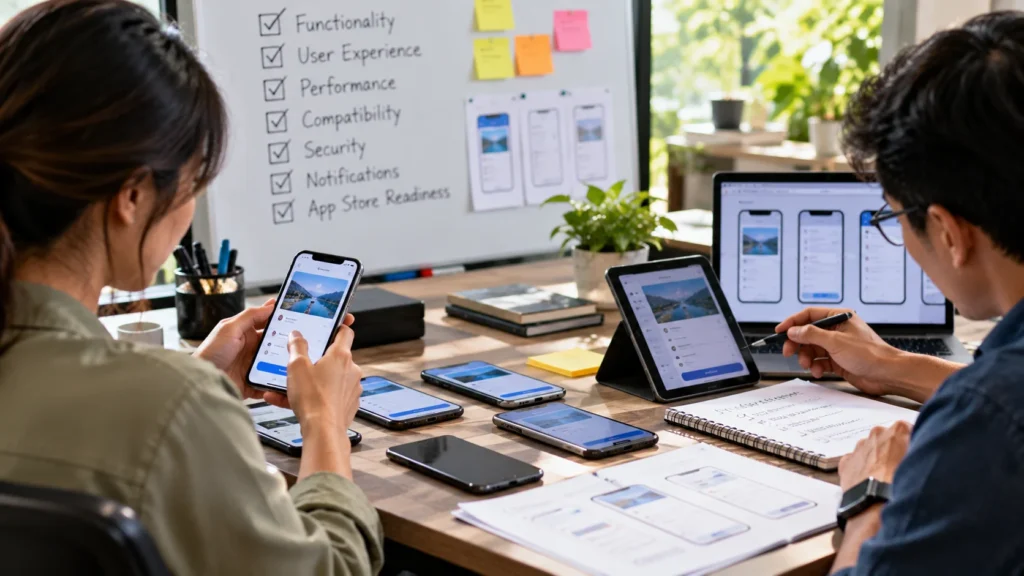
Mobile app testing checklist essentials cover whether users can finish important tasks on supported phones, including when connections fail or someone makes a mistake. Check performance and access to private information as well as functionality. Record what should happen and what actually happens before deciding whether the app is ready to launch.
The booking screen looks finished. Your developer has demonstrated a successful appointment request. Everyone is ready to announce the app.
Then someone tries the same request with a weak signal, taps twice, and creates two bookings.
The demo wasn’t wrong. It just didn’t answer what would happen when the connection dropped. Testing mobile apps means trying those less convenient routes too.
This guide helps business owners and project leads decide what to check before launching a customer app or portal.
What Is a Mobile App Testing Checklist?
It is a repeatable list of checks used before release. It records expected behavior and actual results so the team can identify failures and make a launch decision.
QA means quality assurance. A mobile app QA checklist supports that work, but a tick beside “login tested” tells you very little. Can an existing customer still sign in after a password reset?
That scenario becomes a test case when you add the steps and expected outcome. It gives the mobile app tester something another person can repeat.
Keep the checklist tied to your product. An app without payments does not need checkout checks simply because another checklist includes them.
Our website and app design services help settle what the product needs to do. Testing then checks those decisions against working software.
How Should You Prepare for Mobile App Testing Before Launch?
Start your Mobile App Testing Checklist with the release scope and the build being assessed. Agree on supported devices and who decides whether an unresolved problem blocks launch.
Choose the task that makes the app useful. For a booking product, follow the appointment request through to confirmation. What should the customer see? What must arrive at the office?
Prepare test accounts with different access levels and existing activity. Use fictional records rather than real client documents or patient information.
Use a test environment, a separate setup that avoids affecting live customers. Check that its settings match the intended live setup where that matters to the result.
Our guide to wireframes, prototypes, and mockups explains what design reviews can reveal. A prototype may expose confusing navigation. It cannot prove that a built app stores a booking correctly.
What Should Your Prelaunch Checklist Cover?
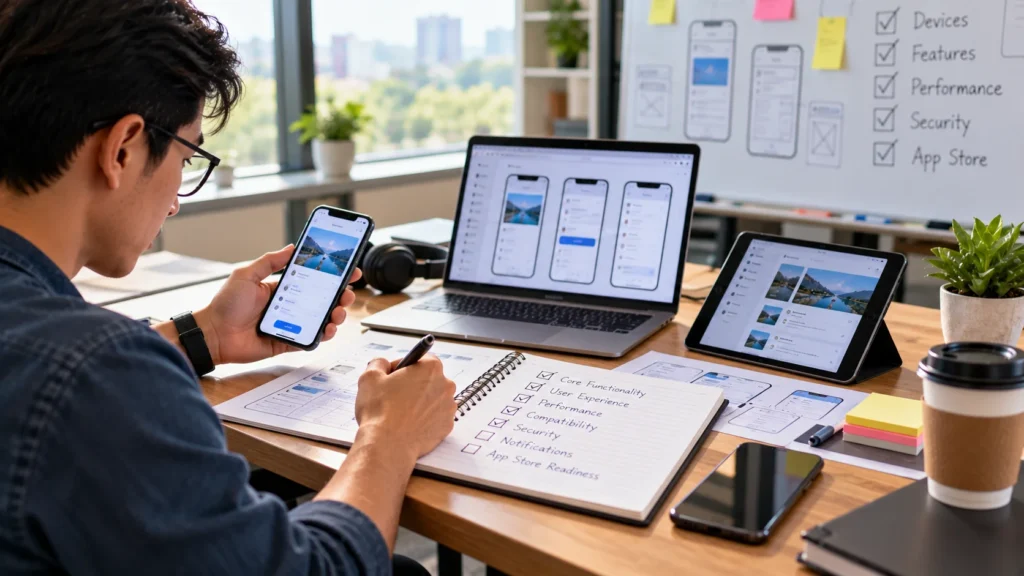
Cover complete customer tasks and the conditions that can interrupt them. These checks are a starting point for mobile application testing, with passing behavior described alongside each test.
Core Functions and Business Rules
Mobile app functionality testing checks whether the product does what you agreed it would do. A functional test might check password recovery. End-to-end testing follows a whole customer journey through to the business record it creates.
- Account access. Test registration, sign-in, password recovery, and sign-out where available. A returning user should regain access through the intended recovery route, and signing out should end access to protected screens.
- The main customer task. Complete a booking, request, or purchase using valid details. Confirm the result reaches the staff system and appears correctly in the user’s account.
- Invalid input. Submit incomplete forms and unsuitable values. The app should explain the problem near the relevant field without discarding valid information unnecessarily.
- Changes and cancellations. Edit or cancel an existing action when the product allows it. The customer view and staff records should reflect the same outcome.
Check availability again when the customer confirms. Someone else may have booked that appointment while the form was open. Decide what the customer sees then.
Weak Connections and Interrupted Tasks
Mobile apps don’t stay on office Wi-Fi. Drop the connection halfway through a request, then see whether the customer can recover without creating a duplicate.
- Connection loss. Disconnect during a save or submission. The app should distinguish a confirmed result from a failed or uncertain attempt rather than showing an unsupported success message.
- Repeated taps. Tap the submit button again while a request is processing. The same request should not create an unintended second booking or charge.
- App switching. Leave the app during a task, then return. Check that it resumes appropriately, with saved progress or a clear explanation when the task must restart.
- External interruptions. Test an incoming call, screen lock, and return from a payment or authentication service where relevant. The app should recover without silently changing the result.
Google’s Core App Quality guidance, accessed October 2026, includes interruptions and connectivity changes. Test them even when the app works perfectly on office Wi-Fi.
Device and Operating System Compatibility
App device compatibility testing checks the phones and operating system versions you promise to support. For mobile apps available on Android and iOS, test both. A shared codebase does not remove that responsibility.
- Supported system versions. Run essential tasks on the oldest supported operating system and current supported versions. Record each combination tested and any exceptions.
- Different screen sizes. Check compact displays and larger screens the app supports. Controls should remain reachable, with important information visible rather than cropped.
- Keyboard and display changes. Open the keyboard in every important form and change orientation where supported. The active field and its next action should remain usable.
- Permissions. Deny camera, location, or notification access where requested. Explain the limitation and allow unrelated functions to continue. Test what happens if permission is later revoked.
Simulators help cover different configurations, but testing on real devices also matters. Include physical mobile devices that reflect your audience, such as an older supported Android phone alongside a newer model. Ask which combinations were checked.
Performance Under Realistic Use
Mobile app performance testing checks responsiveness during actual tasks. Agree on targets for your product and measure against them. A loading-time target borrowed from an unrelated app may tell you very little.
- Opening the app. Measure startup on representative devices, including a fresh launch. Users should reach a usable screen within the agreed target, without a frozen appearance.
- Longer lists and larger files. Use realistic account histories and supported upload sizes. Scrolling, search, and file handling should remain usable as information grows.
- Slow services. Delay responses from connected systems. The app should show progress and provide a sensible failure or retry state if a response does not arrive.
- Repeated and extended use. Repeat core tasks and run longer sessions on real devices. Investigate crashes, increasing memory use, overheating, or unusual battery drain.
Record the conditions beside each measurement. Testing an Android app on a high-end phone with fast Wi-Fi cannot represent every customer’s experience.
Also ask what happens when many customers arrive together. A responsive phone screen doesn’t prove the booking service can handle those requests.
Private Information and Access Controls
Security testing should check that each account can access only permitted information and actions. For mobile applications handling client documents, the systems behind the screens need the same restrictions.
- Account separation. Use different test accounts to attempt access to another customer’s records. The request should be rejected even when someone changes a record identifier.
- Staff permissions. Test each staff role against allowed and restricted actions. Hiding an administrative button is insufficient if the underlying request still accepts unauthorized access.
- Local information and logs. Have the technical team inspect stored files, cached content, and diagnostic logs. Private information should not appear where the app’s security design prohibits it.
- Session handling. Test expired sessions and changes to account access. Protected actions should require valid authorization, with a clear route back to sign-in when needed.
OWASP’s Mobile Application Security Verification Standard, accessed October 2026, covers storage, authentication, and other security controls. This business checklist cannot replace specialist application security testing. Ask whether your app’s risks warrant penetration testing, an authorized assessment that looks for exploitable weaknesses.
Include any staff portal in the scope. Our web development services cover web applications that can accompany a mobile product. A correct phone screen means little if the portal leaves the same records exposed.
Usability and Accessibility
Usability testing shows where people struggle without coaching. Accessibility testing checks whether people can use the app with accessibility features enabled. A correct result is little help if someone cannot reach the submit button.
- Unaided task completion. Ask someone representative of the audience to complete the main task. Observe hesitation and mistakes without pointing out the next button.
- Larger text. Increase the device’s text size. Essential information should remain readable, with buttons and form fields still accessible.
- Screen reader use. Follow the main journey with the platform’s screen reader. Controls need meaningful labels and a sensible focus order, with important status changes announced.
- Touch and visual cues. Check that controls are easy to target and error messages do not rely on color alone. Confirm that important text remains distinguishable from its background.
Google’s Android accessibility guidance, updated September 22, 2026, recommends touch targets of at least 48 × 48 dp, meaning density-independent pixels. That is the tappable area, which may be larger than the visible icon.
Check the relevant platform guidance when reviewing Android and iOS interfaces.
Our UI and UX design services address these interactions. The guide to usability testing explains why watching someone attempt a task tells you more than asking whether they like a design.
Installation, Updates, and Notifications
For mobile apps with existing users, test updates separately from fresh installations. A new account can work perfectly while a returning customer’s saved information fails to load.
- Fresh installation. Install the release build through the intended test distribution route. Confirm that startup and first-use instructions work without developer assistance.
- Updating an existing installation. Create activity in the previous version, then update. Check that required records and settings survive, or that any intended change is explained clearly.
- Notification destinations. Open relevant notifications when the app is closed and already running. They should lead to the correct authorized screen, with sign-in requested when necessary.
- External links. Follow supported links from messages or other apps. Test the intended behavior for an expired link and an account that cannot access the destination.
If storage changes, ask how the team checked existing accounts before approving release.
What Should You Check Before App Store Submission?
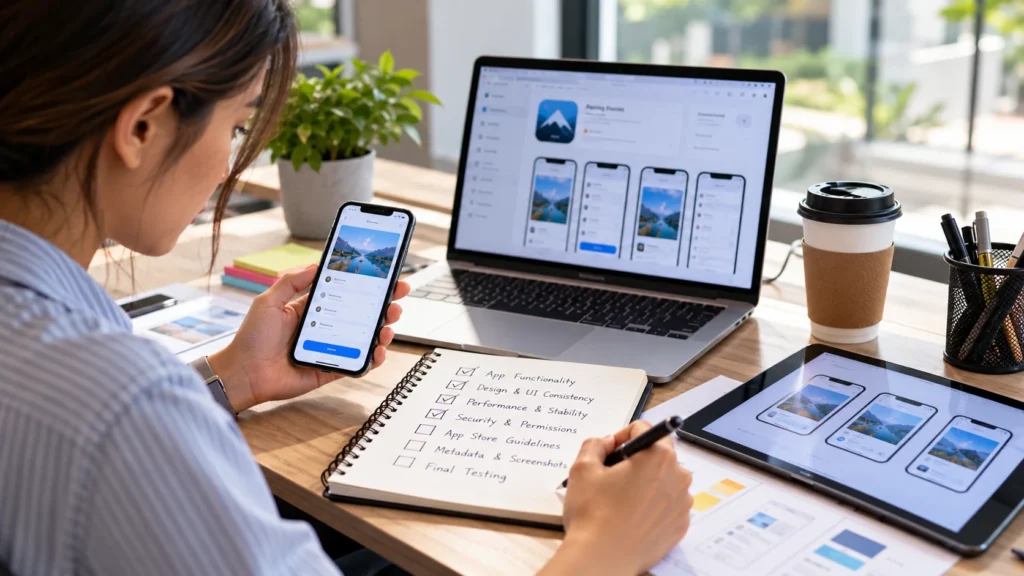
Check the submitted build and listing against the relevant store requirements. Reviewers need working access, and the description must match the product they receive.
Apple’s App Review Guidelines, accessed October 2026, require on-device testing for bugs and stability before submission. Guideline 2.1 also asks for demo account information when an app includes login, with the backend service available for review.
Have someone follow reviewer instructions without developer help. Check access to required screens and support links. Screenshots should show the current product with fictional account information.
Prepare the listing alongside testing. Store approval does not replace your release checks.
Which Failures Should Delay Launch?
Delay launch for failures that expose private information or produce incorrect transactions. A broken essential task can also block release. For smaller issues, consider who is affected and whether a reasonable alternative exists.
Adapt these release decisions to your product’s risks.
| Finding | Recommended Decision | Evidence Needed |
| One customer can open another customer’s record | Block release | Access controls corrected and independently retested |
| Retrying a payment creates a duplicate charge | Block release | Retry behavior corrected and payment results checked |
| Booking fails on a supported device with no alternative route | Block release for that supported scope | Successful end-to-end retest on the affected configuration |
| A nonessential decorative image is misaligned | Consider accepting temporarily | Essential tasks unaffected, with an owner for correction |
“Most tests passed” is insufficient. An access failure can outweigh successful visual checks. Name who accepts any remaining risk.
How Do You Record Results and Retest Fixes?
Record enough detail for another person to reproduce the failure. After a fix, rerun that check and related tasks the change could affect.
A useful test record names the build and device, with steps and expected versus actual results. Attach a screenshot or recording when helpful, using fictional information.
Give unresolved issues an owner and a release decision. “Known issue” doesn’t explain why it is safe to ship.
Retesting confirms that a reported defect has been corrected. Regression testing checks whether the change has broken previously working behavior. Keep both in the plan, particularly after changes to shared account or payment code.
Repeat the essential journey on the exact release build. Testing mobile applications continues after launch too, through monitoring and investigation of failures real users encounter.
Which Mobile App Testing Tools Do You Need?
Choose mobile app testing tools around the checks you need to repeat and the devices you need to cover. Manual and automated testing serve different purposes, so neither should carry the whole testing process.
Automated app testing can repeat account or booking checks after code changes. Manual testing can reveal confusing behavior those scripts miss. Google’s Android testing guidance, updated September 1, 2026, explains both approaches.
Ask your mobile app developers what needs hands-on review. If you use a testing platform, confirm it provides the devices you need, including real Android and iOS devices where hardware matters. Include browser checks for any staff portal or mobile web login.
Frequently Asked Questions
Use these answers when planning your release checks.
Can You Test a Mobile App Without Real Devices?
Simulators and emulators are useful, but they should not be the only evidence for mobile apps used by customers. Test on real phones that represent your audience to check physical interaction and device-dependent behavior.
Is Manual Testing Enough for a Small App?
Hands-on checks can cover important tasks in an early version. As the app changes, automate suitable repeat checks to help catch regressions. Keep specialist security review and observation of real users where the risks require them.
Should You Test an MVP Before Launch?
Yes. A minimum viable product has fewer features, but users still need those features to work. Focus mobile testing on the released tasks and their risks, especially private information and customer transactions.
Does App Store Approval Mean the App Has Passed QA?
No. Store approval does not replace the development team’s testing or the business owner’s release decision. Keep evidence that essential tasks work on supported devices and that unresolved issues have been reviewed.
Make Your Launch Decision With Evidence
A mobile app testing checklist should give you evidence to act on. Before announcing a launch, ask to see the main customer task completed on the release build, along with any problems still open.
Our mobile app development services include QA and real device testing alongside build and launch work. We can help you work out which checks your first release needs.
Book a free consultation with DesignFXPro to discuss your app and what you need to verify before launch.