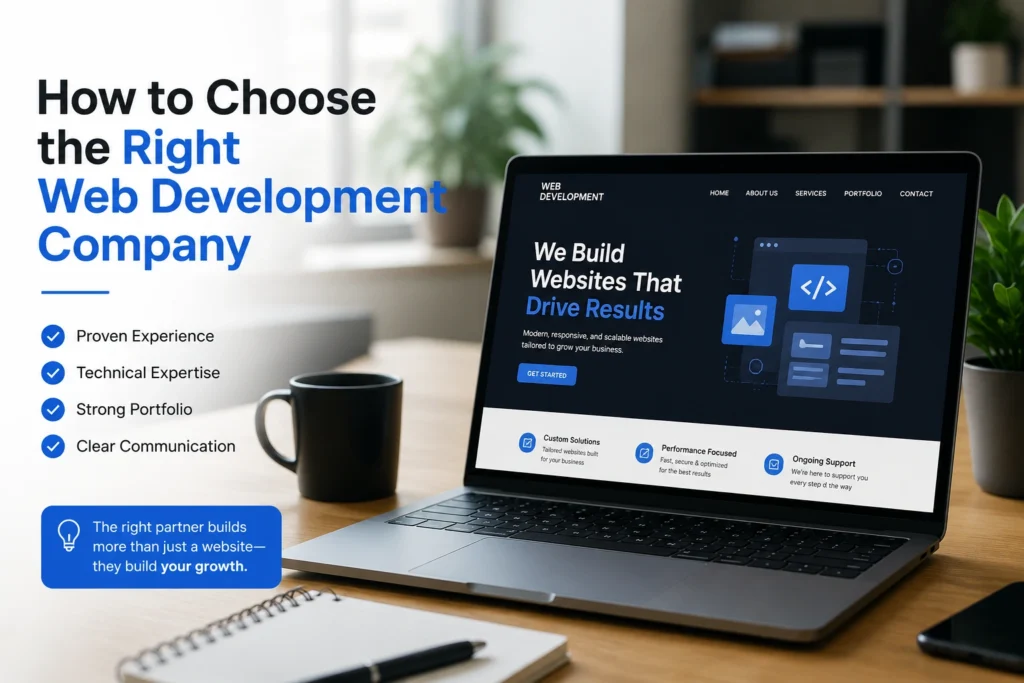
To choose the right web development company, judge it on five things: a portfolio of work similar to yours, clear and responsive communication, a transparent process, a real post-launch support plan, and honesty about timelines and cost. The flashiest portfolio or the lowest quote should never be the deciding factor, because the wrong partner costs you a rebuild within a year or two.
That’s the whole answer in a paragraph. Now the part that actually helps, because knowing the criteria and applying them under a sales pitch are two very different things. You’re probably reading this because you’ve got a website project ahead of you, you’ve started gathering quotes, and every agency’s site looks roughly the same. Polished work, confident promises, a list of services that could be copy-pasted between them. It’s genuinely hard to tell who’s good from the outside, and the cost of guessing wrong is high.
So let’s make it easier. We’ll walk through what actually separates a strong partner from one that just markets well, the questions that cut through the polish fast, and the warning signs worth taking seriously before you sign anything.
Why This Decision Matters More Than It Used To
Your website isn’t a digital brochure anymore. It’s often your first salesperson, your support desk, and your credibility check all at once, and for many businesses it’s tied directly to sales and revenue. That’s why hiring a web development company is less like buying a service and more like choosing a long-term partner. The trouble is that hundreds of them all look reliable on the surface, so the real skill is telling them apart.
The numbers make the stakes concrete. According to Clutch, 75% of customers judge a company’s credibility based on its website, and 53% of mobile users leave a site that takes longer than three seconds to load. Get the build right and you’ve got an asset that compounds for years. Get it wrong and you’re looking at a costly rebuild, often within eighteen months, plus all the leads you quietly lost in the meantime. The right web development company turns your site into that compounding asset. Most businesses that regret their website don’t regret the idea. They regret the execution partner they picked.
Start By Knowing What You Actually Need
Here’s the uncomfortable truth most guides skip. A lot of businesses approach developers without really knowing what they want. They say things like “we need a modern website” or “something better than what we have.” That’s not a requirement. It’s a vague intention, and vague intentions get vague results.
Before you talk to anyone, get clear on what the site needs to accomplish. Is it lead generation, online sales, bookings, brand credibility, or some mix? Roughly how many web pages, and what functionality, like payments, a client portal, a booking system, or integrations with tools you already use? It’s also worth a thought on whether you want a content management system like WordPress so your team can update content yourselves, or something fully custom. Knowing this does two things. It lets agencies give you accurate proposals instead of guesses, and it makes you a much harder client to upsell on things you don’t need. The clearer your brief, the more honest the conversations that follow.
You don’t need a technical specification. You’re not the one building it. But you do need to know your goals well enough to recognize when an agency is solving your actual problem versus selling you a package. A quick test: if a developer asks what you want the site to do and your answer is mostly about how it should look, spend a little more time on the why before you start collecting quotes. Good design matters, but a beautiful site that doesn’t generate leads is an expensive disappointment.
What Separates The Right Web Development Company From An Average One
Plenty of shops can ship a working website. The real difference shows up before, during, and after the build, and it’s where you should focus your attention. Knowing how to choose a web development company comes down to reading these signals correctly.
A few things genuinely matter when you’re evaluating, and they’re not weighted equally:
- A relevant portfolio, not just a pretty one. Anyone can show polished mockups. Ask for live websites they’ve built, ideally for businesses like yours, and actually click around them. Real case studies that explain results matter more than screenshots, and a quick look at client reviews on a platform like Clutch helps you get a sense of whether they deliver. A law firm needs a partner who understands law firm sites, not one whose best work is all restaurants.
- Communication during the proposal stage. This one predicts everything. If replies are slow, vague, or inconsistent while they’re still trying to win your business, it only gets worse once the contract is signed. Clear communication early, the kind where the development team asks questions and sets expectations, is the single most reliable signal you’ll get.
- A transparent development process. A serious team can explain how they work, what the stages are, and what they need from you at each one. Vagueness about the process usually means there isn’t much of one. This is one of the real factors to consider when choosing, far more telling than a glossy pitch deck.
- Post-launch support that’s spelled out. Launch is the start, not the finish. Find out exactly what happens after, who handles updates and fixes, what the turnaround is, and what it costs. A good agency is upfront here. One whose post-launch plan is fuzzy tends to disappear once the invoice clears.
- Scalability and the fundamentals baked in. A strong development team builds with growth in mind so the site can adapt without breaking, and follows the best practices that affect results, fast performance on mobile devices, clean code search engines can read, and SEO from day one rather than bolted on later. Some agencies also fold in digital marketing, which helps if you want one partner driving traffic as well as building the site. If nobody brings up scalability or SEO early, both become expensive problems down the line.
Notice that only one of those is about raw technical skill. The rest are about how the team operates as a partner, which is exactly what most people underweight when they’re dazzled by a slick presentation.
The Questions That Cut Through The Pitch
You learn more from how a team answers a few sharp questions than from any amount of marketing copy. These are the questions to ask a web developer before you commit, and the answers tell you fast whether you’re talking to a real partner or a smooth sales process. The right web development company welcomes these questions rather than deflecting them.
Worth asking, and worth listening carefully to the answers: Can you show me three projects similar to mine and explain the results, not just the look? Who exactly will be working on this, and can I talk to them rather than only the salesperson? What does your process look like from start to launch? What happens after launch, and what does ongoing support cost? How do you handle changes or problems mid-project? What do you need from me to keep things on schedule?
A strong company answers these plainly, including the uncomfortable parts about trade-offs and timelines. If every answer sounds perfect and frictionless, something’s being left out, because honest teams are upfront about what’s hard. Pay attention to whether they ask you questions back, too. A partner genuinely trying to understand your business will want to know about your customers, your goals, and your existing systems before they ever quote a price.
Warning Signs Worth Walking Away From
Some red flags are loud if you’re listening for them. The biggest is unrealistic promises. Anyone who says they’ll build a complex platform in two weeks, or guarantees you’ll rank number one on Google, is either inexperienced or not being straight with you. Quality work takes real time, and no honest agency promises rankings they can’t control.
Watch for a few other patterns too, and none of these are subtle once you know to look:
- A team that leads with their tech stack instead of asking about your business is solving the wrong problem first
- Pricing dramatically lower than everyone else, which usually means corners get cut somewhere you’ll feel later
- A vague or evasive answer about what happens after launch, which in our experience is the single most reliable predictor of a partner who disappears once the site goes live
- No clear point of contact, or a different person responding every time, which signals disorganization that will show up in the work
- Reluctance to share references or let you speak with past clients, which is rarely a good sign
Trust the patterns. They rarely lie, and the cost of ignoring them is measured in months and rebuilds rather than minor inconvenience.
A Word On Price, Because Everyone Asks
Beyond the build itself, remember that website design and the ongoing costs that follow, hosting, updates, support, all factor into what you’re really paying. The cheapest option is almost never the cheapest outcome. We say that knowing how it sounds coming from an agency, but the math is real. A poorly built site costs you in lost customers, in maintenance headaches, and eventually in the full rebuild you’ll pay for anyway when the cheap version can’t keep up.
For context on what’s normal, a professional business website with custom design typically runs somewhere between eight thousand and twenty-five thousand dollars, while an e-commerce website and more complex builds go higher. Many established agencies also set a minimum project fee, often in the ten to twenty-five thousand range, simply because serious work isn’t viable below that. None of this means expensive automatically equals good. Whether you’re after a simple new website or a fully custom website, price should be weighed against capability, communication, and support, not treated as the headline number. The right web development company is the one whose value justifies its price, and choosing a web design company on price alone is how most website regrets begin.
Local Or Remote, Does It Matter?
A quick note, since a lot of people start by searching for a company near them. Local can be great if your project needs frequent in-person sessions or you want a partner who knows your specific market. But in 2026, remote website development is completely normal, and some of the strongest web development agencies work entirely online with clients across time zones. Don’t rule out a clearly better remote partner just because they’re not down the road. How well a team communicates matters far more than how close they are.
Frequently Asked Questions About Choosing A Web Development Company
How do I know if a web development company is actually good?
Look past the portfolio. Ask for client references from projects like yours, request to speak with the engineers rather than just the salesperson, and notice how they handle your first discovery conversation. A good sign is a team that talks about measuring results, setting up Google Analytics, tracking conversions, rather than just delivering a site and walking away. Companies that ask sharp questions about your business before pitching technology consistently outperform those that lead with their stack.
How much does it cost to hire a web development company?
A professional business website with custom design generally costs between $8,000 and $25,000, while e-commerce and complex platforms run higher. Many web development companies also set a minimum project fee of roughly $10,000 to $25,000. Price should be weighed against capability and support rather than treated as the only factor.
What is the difference between a web development agency and a web design company?
A web design company typically focuses on the visual side, layout, branding, and user experience, while a web development agency builds the functioning, coded site behind that design. Web designers shape how it looks and feels, developers make it work. In 2026 the line is blurring, and many strong firms handle both web design and development under one roof.
What questions should I ask before hiring a web developer?
Ask to see three similar projects with real results, who will actually do the work, what their full process and timeline look like, what post-launch support costs, and how they handle mid-project changes. The clarity and honesty of the answers reveal more than any sales deck can.
Should I choose a local web development company or a remote one?
Either can work well. Local teams suit projects needing in-person collaboration or local market knowledge, while remote teams are completely standard in 2026 and often expand your options. Prioritize communication quality and relevant experience over physical location.
Ready To Work With A Partner?
If this guide gave you a clearer sense of what to look for, good, that’s the point. The right partner should make you feel like they’re an extension of your business, thinking ahead and guiding decisions, not just taking an order and disappearing.
At DesignFxPro, we try to be exactly that kind of web development agency for law firms, clinics, e-commerce brands, and service businesses. We start every project by understanding what your business actually needs before we talk technology, we’re upfront about timelines and cost, and we don’t vanish after launch.
Book a free consultation with DesignFxPro. Ask us the hard questions from this guide. We’d rather earn your trust by answering them honestly than win you over with a pitch, because the right web development company has nothing to hide behind.