
Think about the last website you used. Maybe you booked a flight, read the news over coffee, or ordered lunch without thinking twice. Someone built that. Every button that did what you expected, every page that loaded when you tapped it, sits on top of a layer of code that somebody wrote and somebody maintains. That work is what is web development, and it’s happening behind basically everything you do online.
Here’s the thing though. The term gets thrown around constantly and almost never explained in a way that actually helps. Agencies use it. Developers use it. You nod along because you know your business needs it. But what does it really mean, and more to the point, what does it mean for you and your money?
That’s what this is for. No jargon, or at least as little as I can get away with. Just a clear walk through what web development is, who does it, the different flavors of it, and why it matters to your bottom line whether you’re a law firm, a clinic, a shop, or a startup still figuring things out.
A Simple Definition of What is Web Development
Strip it all the way down and web development is just the work of building and maintaining websites and web applications. That covers a lot of ground. A five-page site for a local plumber counts. So does a platform pushing millions of transactions a day. When people ask what web development really means, the honest answer is that it’s the process of turning a design and a list of requirements into something that works on the internet and does the job your business needs done.
What does that work look like in practice? Writing code in a handful of programming languages. Connecting databases. Building the machinery that lets someone click a button and have something happen. Making sure none of it breaks when a visitor shows up on an old phone instead of a new laptop. Part engineering, part puzzle-solving, and these days a fair bit of strategy too.
People mix up web development and web design all the time, and the two really aren’t the same. Design is the look and the feel. Colors, layout, fonts, the overall vibe. Development is what makes the thing function. They lean on each other heavily, sure, but they’re separate skills. A designer hands over a vision. A developer makes that vision do something.
The house analogy gets overused but it works. An architect decides how the place should look and how you move through it. The crew and electricians make it stand up and turn the lights on. Design is the architecture, development is the construction. Skimp on either and the whole thing feels off.
Web Development vs Web Design
Since these two get used interchangeably so often, it’s worth slowing down on the difference. It actually changes who you hire, what you’re paying for, and how you decide whether a project went well.
Design lives on the visual side. The designer picks the brand colors, settles on fonts, lays out each page, maps how someone moves from the homepage to wherever you want them to end up, and produces mockups so everyone can see the plan before a line of code exists. Figma and Adobe XD are the usual tools. What you get at the end is a blueprint.
Then development takes that blueprint and builds the real thing. The developer writes the code that turns a flat mockup into a site you can click around in. They wire the contact form to an inbox, get the shopping cart working, make the buttons respond, and make sure the whole thing loads fast and behaves on every screen size someone might throw at it.
In reality the line gets blurry, and honestly that’s a good thing. Front-end developers think hard about design because they’re the ones bringing it to life. Plenty of designers know enough code to avoid drawing something that can’t be built. The best projects are the ones where both sides talk constantly instead of treating the handoff like tossing a file over a fence.
The Main Purpose of Web Development
So what’s the point of all of it? The main purpose of web development is building an online presence that works, that people can rely on and reach, and that pushes toward a specific goal. Looking at what is web development from this angle means caring less about the code and more about what the code produces. The goal shifts depending on who’s asking. A shop wants to sell. A law firm wants consultations. A clinic wants booked appointments. A publisher wants people reading and sticking around.
The common thread is that the site has to do something. It can’t just sit there looking nice. A pretty brochure parked on the internet isn’t earning its keep. A site built well nudges visitors toward an action, keeps their information safe, loads before they lose patience, and works the same on a phone as on a desktop.
And then there’s maintenance, which everybody forgets until it bites them. A website isn’t a build-it-and-walk-away thing. It needs updates, security patches, performance tuning, the occasional rework as your business changes. Ignore a site for a few years and it slowly turns slow, insecure, and dated, quietly bleeding traffic and trust the whole time.
The Three Main Types of Web Development
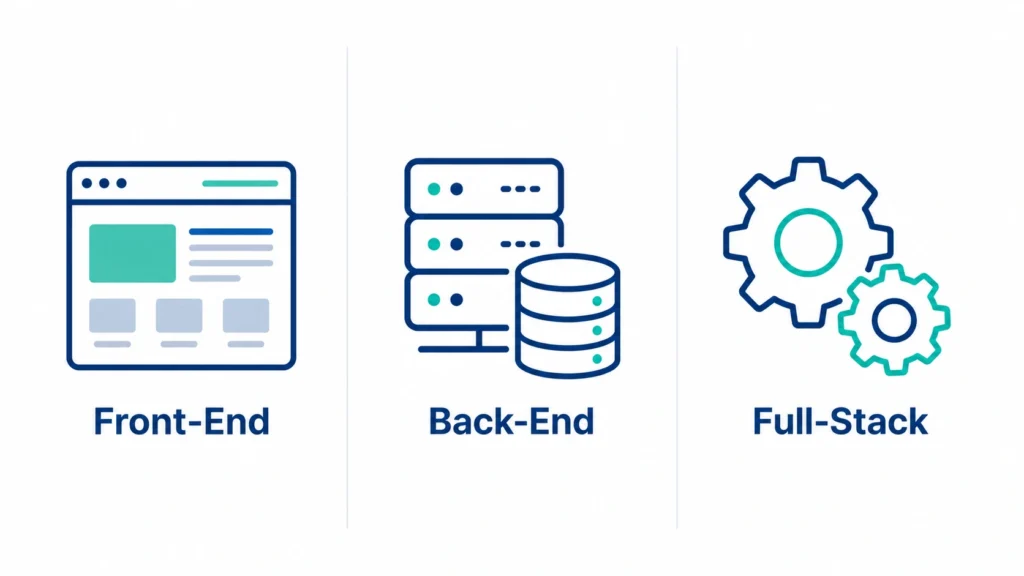
Web development splits into three broad buckets, and knowing them helps you understand what you’re actually hiring someone to do.
- Front-end is the part you see and touch. Layout, buttons, navigation, forms, the little animations. Front-end developers mostly live in HTML, CSS, and JavaScript, leaning on frameworks like React, Vue, or Angular to build interfaces that feel alive.
- Back-end is the opposite, everything you don’t see. The server, the database, the logic running quietly underneath. When you log in, submit a form, or pay for something, the back-end catches that request, stores what needs storing, and sends back the right answer. The languages run to Python, PHP, Ruby, Node.js, and Java.
- Full-stack just means both. A full-stack developer can take a project from the interface down to the server and database on their own, which is genuinely useful on smaller builds or lean teams where one person owns the whole thing.
Most real projects blend all three anyway. A big build might have dedicated front-end and back-end people, while a smaller site might be one full-stack developer handling everything start to finish.
The Languages and Tools Behind Web Development
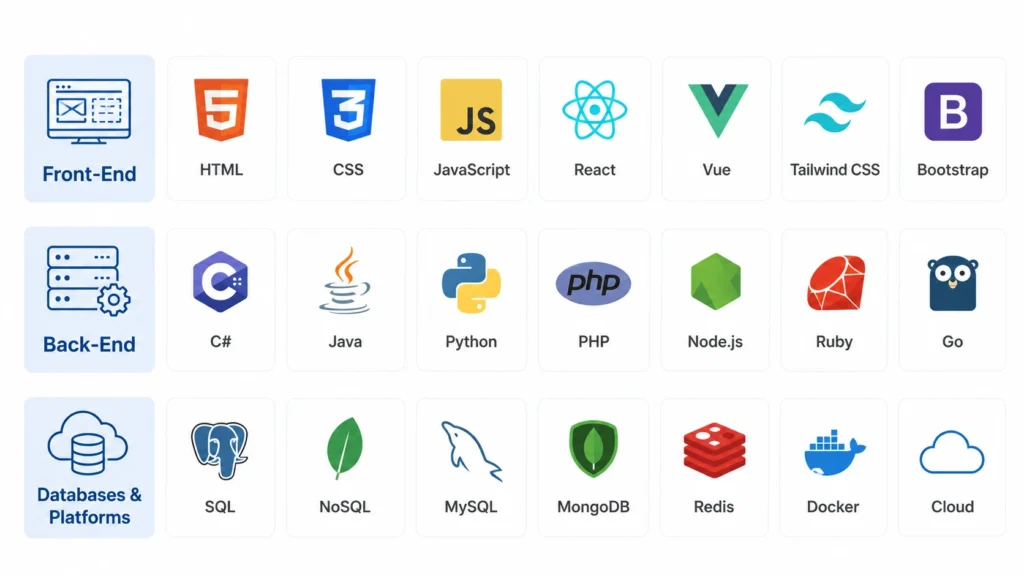
You don’t need to write code yourself to make good calls about your website. But knowing the building blocks, even loosely, helps you understand what you’re paying for and ask sharper questions. A handful come up over and over:
- HTML is the skeleton. It defines structure on every page out there, the headings and paragraphs and images and links. Nothing on the web exists without it.
- CSS handles how all of that looks. Colors, spacing, fonts, and how things rearrange on a smaller screen. It’s the difference between raw text and something that looks designed.
- JavaScript is where the interactivity lives. Dropdowns, sliders, form validation, anything that reacts to what you do.
- Back-end languages like Python, PHP, Ruby, and Node.js run the server logic, processing data, managing accounts, and enforcing whatever rules your business runs on.
- Databases like MySQL, PostgreSQL, and MongoDB are where the actual information sits, user profiles, product catalogs, order histories, all of it.
- Frameworks and CMS platforms like React, Vue, Laravel, and WordPress exist to save time, handing developers pre-built pieces so nobody reinvents the basics every project.
Which stack a project uses depends on what’s getting built. A simple brochure site might run on WordPress with barely any custom code. Something more involved might use React up front, Node.js behind it, and PostgreSQL underneath. Neither’s better in the abstract. It comes down to the goals and how much the thing needs to grow.
Types of Websites and Web Applications
Web development isn’t one thing, and the kind of project you need shapes everything else, the timeline, the cost, the approach. So it helps to know roughly where you land:
- Static websites show the same fixed content to everyone. Quick, cheap, and perfect for a small business site, a portfolio, or a simple landing page.
- Dynamic websites are a step up, pulling content from a database and changing what they show based on the user. News sites, blogs, and most business sites work this way.
- E-commerce sites are their own beast. Built for selling, which means product catalogs, carts, secure payment processing, and order management, all adding complexity on top of a standard site.
- Web applications go further still, basically full software products that happen to run in a browser, your project management tools, online banking, booking systems. The most complex and resource-hungry thing you can build.
- Progressive web apps sit in an interesting middle spot, giving you the reach of a website with some of the feel of a mobile app, working offline in limited ways and installable to a home screen without touching an app store.
Figuring out which bucket you’re in is one of the first things any decent development partner works through with you, because it drives the budget, the timeline, and the whole technical plan.
What Is a Web Developer?
So what is a web developer when you get specific? It’s the person who writes the code that builds and runs websites and web apps. They take a design, a pile of requirements, or both, and turn it into something that works in a browser. Simple enough on paper.
The job’s wider than just typing code, though. The good ones are problem solvers more than anything. They’re thinking about how the site holds up under traffic, how to keep it secure, how to structure it so it can grow without falling apart, how to make sure someone using a screen reader can actually use it. Hundreds of small decisions you’ll never see but that quietly decide how well the finished thing works.
Most developers specialize to some degree. Some stick to front-end and the user-facing side. Some are back-end people happiest deep in servers and databases. Some are full-stack generalists comfortable across the whole thing. And a lot of them work next to designers, project managers, and SEO folks as part of a bigger team pushing toward the same goal.
What Does a Web Developer Do Day to Day?
If you want to set realistic expectations for a project, it helps to know what does a web developer do once the work actually starts. It’s a lot more than sitting in a corner writing code in silence.
On a given day, a developer’s turning a design file into responsive code that holds up across devices, building and hooking up databases that store your users or products or content, and wiring in third-party services, payment processors, booking tools, a CRM. There’s testing across browsers to catch bugs before real people do, performance work so pages load fast, and once the site’s live, the steady stream of fixes and updates that keeps it healthy.
There’s also way more talking than people expect. Developers sit with clients to pin down what’s needed, go back and forth with designers to keep the build true to the vision, and document their work so someone can maintain it later. The good ones spend a real chunk of their time just understanding the problem before they write anything.
The Web Development Process Step by Step
Most professional projects follow a similar arc, even if the specifics shift around by scope. Knowing the stages tells you what to expect and, just as usefully, where your own input actually moves the needle.
It starts with discovery and planning, before anyone writes a line of code. The team digs into your goals, your audience, what the site even needs to pull off. Requirements get nailed down, the sitemap gets sketched, the scope gets agreed on. Rush this part and you’ll usually pay for it later, it’s the single most common reason projects go sideways.
Design comes next. Wireframes lay out the bones, then mockups show what each page is going to look like, with rounds of feedback before anything gets built. Then development, the actual building, which is usually the longest stretch. Front-end people turn the approved designs into working interfaces while back-end people build the logic and databases, and it all gets stitched together.
Before launch, everything gets tested across browsers, devices, and screen sizes. Forms checked, performance measured, bugs squashed while they’re still cheap to fix. Launch itself means moving everything to the production server, sorting out hosting, setting up analytics, one last round of checks live. And then maintenance, the part everyone underestimates. Updates, patches, monitoring, content changes. Maintained sites stay fast and safe. Neglected ones rot.
A small business site might run through all of that in a few weeks. A complex web app can take months. It comes down to scope, and any partner worth hiring gives you a realistic estimate instead of a hopeful one.
How Web Development Helps Your Business Grow
This is the part that actually matters if you’re running a business. Understanding how building a website helps your business grow is what flips web development from some abstract technical thing into an investment you can feel.
A site that’s built right works around the clock. It’s your most visible salesperson, your first impression, often the thing that tips someone toward you instead of the competitor one tab over. And the numbers aren’t subtle. Roughly 75% of people judge a business’s credibility on its website, and they form that judgment in about 50 milliseconds, faster than a blink. A site that’s slow, broken on mobile, or just dated pushes customers away before they ever reach out. 88% say they won’t come back after one bad experience. Most of them, gone, over something fixable.
It goes past first impressions, too. Faster load times pull bounce rates down and conversions up, and every extra second of load can shave conversions by around 4%. Mobile responsiveness matters because roughly 62% of all web traffic is on phones now, not desktops. Clean, well-structured code helps you rank in search and brings in traffic you didn’t pay an ad network for. Design built around the actual user can lift conversions meaningfully. Solid security protects you and your customers, which is really protecting your reputation. And scalability means the site grows with you instead of needing a full teardown every time you expand.
Put all of that together and the site becomes a genuine engine for growth. Skip it, and you’ve got a liability quietly costing you customers you’ll never even know you lost. This is the piece of what is web development that business owners care about most, and they’re right to.
How to Choose a Web Development Partner
If you’re not building this yourself, who you pick might be the most consequential decision in the whole thing. A few things worth weighing when you’re sizing up developers or agencies.
Look at their portfolio, specifically for work that’s close to what you need. An agency that’s built effective law firm sites already gets the particular headaches of a law firm site. Ask about their process too. A good partner can walk you through how they work and what they’ll need from you at each step, and if they’re vague about it, that’s a flag. Be wary of anyone promising a complex site impossibly fast or suspiciously cheap, because real development takes time and costs real money.
Performance and SEO matter more than people expect here. A gorgeous site that loads slowly and can’t be found in search isn’t doing its job, so you want someone who builds with speed and visibility baked in from the start. And find out what happens after launch, because a partner who vanishes the moment the site goes live leaves you stuck the first time something breaks.
One last thing. The cheapest quote is rarely the cheapest outcome. A badly built site costs you more over time, in lost customers and the rebuild you’ll eventually pay for anyway. A well-built one quietly pays for itself, over and over.
What is Web Development and Where Is It Headed
The field doesn’t sit still, and a couple of shifts are worth having on your radar. AI is working its way deeper into web development, from coding assistants that speed up builds to AI features dropped right into sites, chatbots, personalization, that kind of thing. Something like 93% of web designers are using AI tools now, which would’ve sounded absurd a few years back. Meanwhile the bar on performance and accessibility keeps climbing. Google’s Core Web Vitals made speed a literal ranking factor, and accessibility has gone from nice-to-have to both a legal and practical must.
None of it really changes the fundamentals, though. A good website still has to load fast, work everywhere, say what it does clearly, and move people toward doing something. The tools keep getting fancier. The goal stays exactly where it’s always been.
Frequently Asked Questions About Web Development
What is web development in simple terms?
Web development is the process of building and maintaining websites and web applications. It involves writing code, connecting databases, and creating the systems that let people interact with a site. In plain terms, it turns a design and a set of requirements into a working website that lives on the internet and does a job for your business.
What are the three main types of web development?
The three main types of web development are front-end, back-end, and full-stack. Front-end development handles everything users see and interact with, back-end development powers the server, database, and logic behind the scenes, and full-stack development covers both. Most real projects combine all three.
What is the difference between web development and web design?
Web design covers how a site looks and feels, including colors, layout, typography, and the overall user experience. Web development covers how the site actually works, turning that design into functioning, coded pages. Design is the visual blueprint, and development is the construction that brings it to life.
How long does it take to build a website?
A simple small business website typically takes a few weeks to build, while a complex web application can take several months. The timeline depends on the scope, the number of features, and how much custom design and functionality the project requires.
Why is web development important for a business?
Web development is important because a well-built website works as a 24/7 salesperson, builds credibility, and drives growth. Around 75% of consumers judge a business’s credibility based on its website, and they form that first impression in roughly 50 milliseconds. A fast, professional, mobile-friendly site directly affects how many visitors become customers.
Ready to Build Something That Actually Works?
Understanding what is web development is a start. Having a team that’s actually good at it, and that builds around your specific goals, is what turns understanding into results. Your website should be an asset that earns its keep, not a digital business card collecting dust.
At DesignFxPro, we handle the whole picture. Front-end, back-end, performance, security, and the strategy holding it together. We build for law firms, clinics, e-commerce brands, and service businesses, and we start every project by understanding what you’re trying to do before writing a single line of code.
Book a free consultation with DesignFxPro. We’ll look at what you need, give you honest answers, and show you what a website built to grow your business looks like.