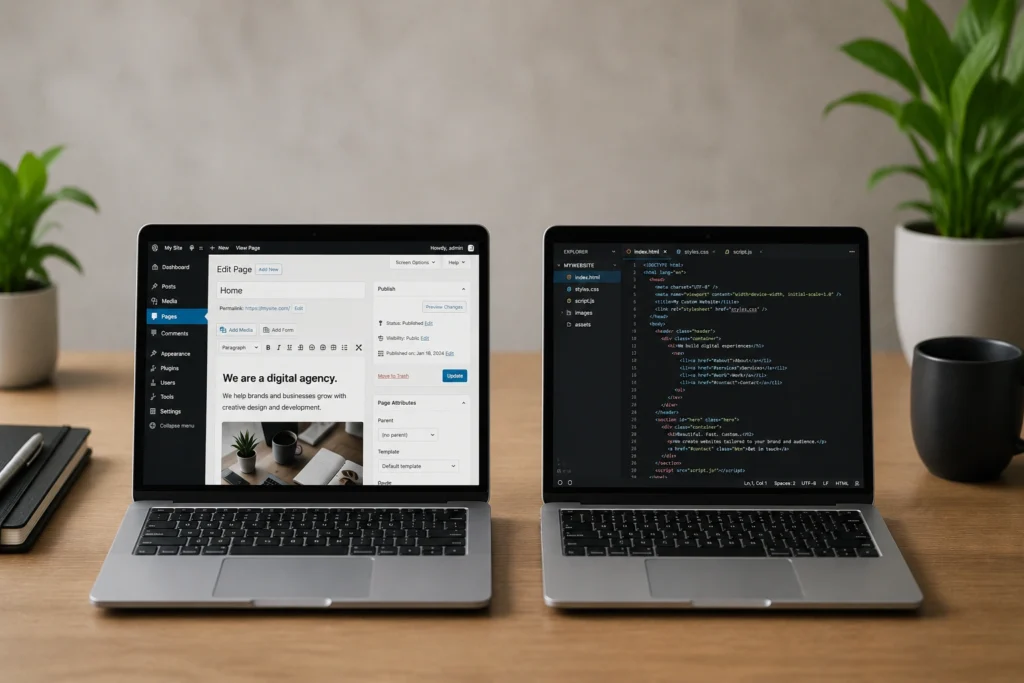
One of the earliest decisions any business faces when building an online presence is also one of the most consequential: do you go with WordPress, or do you have a website built from scratch? It’s a question that comes up constantly, and the honest answer isn’t the same for everyone. The right choice depends entirely on where your business is right now, where it’s headed, what your budget looks like, and how much control you actually need over how your site functions.
The wordpress vs custom website debate has been going on for years, and most of the content out there on the topic is written by agencies or developers who already know which answer they want you to arrive at. What we’re going to do here is lay out both sides clearly, honestly, and with enough specifics that you can actually make an informed decision for your situation.
And to be clear upfront, this isn’t a guide written to sell you on one option over the other. The wordpress vs custom website choice is genuinely situational, and the wrong answer is whichever one you pick without properly understanding what you’re getting into.
By the end of this guide, you’ll know what each option involves, what it costs in real terms, who it’s right for, and what questions to ask before you commit either way.
What Is WordPress, Actually
WordPress is an open-source content management system, or CMS, that powers roughly 43% of all websites on the internet as of 2025. That’s not a small number. It runs everything from personal blogs to the websites of major publishers, large e-commerce operations, and global brands.
The reason it’s so widely used is that it gives people with no coding background the ability to build and manage a functional website by choosing a theme, installing plugins for additional functionality, and editing content through a relatively accessible interface. Over 60,000 plugins are available, covering everything from SEO tools to booking systems to payment processing to CRM integration.
WordPress advantages include the speed at which a site can go live. A professional WordPress site can typically be built and launched in two to six weeks. Beyond speed, here’s where WordPress genuinely earns its reputation:
- Lower upfront cost compared to custom development, both in build time and developer rates
- Over 60,000 plugins covering SEO, booking systems, payment processing, and CRM integration
- A large global community of developers and designers, which makes finding support straightforward
- Beginner-friendly content management so your team can update the site without calling a developer every time
- Faster launch timelines, meaning you can be live and generating leads while a competitor is still in build phase
WordPress disadvantages are real too, and they’re worth being honest about. Here’s what to watch for:
- Because WordPress is such a widely used platform, it’s among the most frequently attacked on the web. Security requires active maintenance, not just a one-time setup.
- Performance can degrade over time with poorly chosen plugins or bloated themes
- Plugin conflicts are more common than most people expect and can create technical issues that require developer time to resolve
- Flexibility has a ceiling. If your business needs functionality outside the plugin ecosystem, you’re looking at custom development regardless
What Is a Custom Website
A custom website is built from the ground up using languages like HTML, CSS, JavaScript, and frameworks such as React, Vue, Laravel, or Node.js. Nothing is borrowed from a template. Nothing is adapted from an existing theme. Every element of the site is purpose-built for your specific needs, your brand, your functionality requirements, and your performance goals.
Custom website advantages are most visible at scale and complexity. Here’s what you actually get with a custom build:
- No unnecessary code, no plugin conflicts, no inherited limitations from someone else’s architecture
- Faster load times because every line of code was written with a specific purpose
- Full design freedom with no structural constraints carried over from a theme
- Functionality built specifically for your workflows, including integrations no plugin was ever designed to handle
- Long-term scalability built in from the start, not bolted on later
The design freedom is also genuinely different. A WordPress theme, even a heavily customized one, carries structural constraints from its original architecture. A custom build has none of those. Your UI/UX designer works with a blank canvas, and the result can reflect your brand at a level of fidelity that templates simply don’t allow.
Custom website disadvantages come down primarily to cost and time:
- A professional custom website typically takes three to six months to build, sometimes longer for complex projects
- The upfront investment is substantially higher than WordPress
- Post-launch updates and maintenance generally require developer involvement rather than being manageable in-house
- If your agency relationship ends, onboarding a new team takes longer because the codebase is proprietary rather than universally understood
WordPress vs Custom Website: Comparing the Two Side by Side
The wordpress compared custom website decision comes down to a few core dimensions, and it’s worth looking at each one honestly.
Cost: WordPress is almost always cheaper upfront. A professional WordPress site might cost anywhere from a few thousand dollars to twenty or thirty thousand depending on complexity and custom design work. A fully custom-built website for a business with complex requirements can run from thirty thousand to well over a hundred thousand. Ongoing maintenance costs also differ: WordPress requires regular updates and security management, while custom sites require developer time for any changes beyond content updates.
Time to launch: WordPress wins decisively. If you need to be live in six weeks, a custom build usually isn’t a realistic option. If your timeline is more flexible, the extra time a custom build requires may be entirely worth it for what you get.
Flexibility and scalability: For most small to mid-sized businesses, WordPress covers the vast majority of what they’ll ever need. For businesses with genuinely complex requirements, high traffic volumes, unique functionality, or serious long-term ambitions around a proprietary digital product, custom development starts to look like the right investment.
Security: WordPress is more vulnerable to mass attacks by virtue of its popularity and predictable architecture. That’s manageable with proper maintenance, good hosting, and security plugins. Custom sites are less of a mass target, but security depends entirely on the quality of the development. Bad custom code isn’t inherently safer than WordPress.Content management: WordPress is designed for non-technical users to manage content. Custom sites can be built with a CMS component, but this adds cost and complexity. If content updates are frequent and you want to manage them in-house, WordPress has a clear advantage.
Who Should Choose WordPress
WordPress is the right starting point for most small businesses, startups, service providers, law firms, healthcare practices, and e-commerce operations that don’t have highly specific technical requirements. You’re probably in this category if:
- You need to be live within weeks, not months
- Your budget is more limited than your ambitions right now
- You want to manage content updates in-house without relying on a developer
- Your functionality needs are standard, booking forms, payment processing, portfolio pages, blog, contact
- You’re still learning what your users need and want a live product to test with
It’s also the right choice if you’re still figuring out exactly what your site needs to do. A WordPress build gives you a professional presence while you learn what your users actually want, which makes any later custom development decisions far more informed.
Who Should Choose a Custom Website
A custom build makes sense when your business has outgrown what WordPress can realistically handle, or when you’re building something from the start that requires functionality or design specificity that no plugin ecosystem can deliver. In those cases, the wordpress vs custom website question answers itself once you map out what you actually need the site to do. Consider custom if:
- Your business processes require integrations with proprietary or complex internal systems
- You have high transaction volumes or significant traffic that demands optimized performance
- Your brand’s visual identity is a core part of the product experience, not just a surface consideration
- You need custom user flows, dashboards, configurators, or application-level features
- Long-term scalability is a priority and you’re planning to grow significantly in the next two to three years
It’s also worth considering if long-term performance matters more than time to market. A well-built custom site with clean, purpose-written code will typically outperform a plugin-heavy WordPress installation under load, which becomes more important as traffic grows.
The Decision Is Yours, But You Don’t Have to Make It Alone
The wordpress vs custom website question doesn’t have a universal right answer, which is exactly why it’s worth talking through with someone who builds both and has no agenda to steer you one direction for the sake of their preferred tech stack.
At DesignFxPro, we build WordPress sites and custom websites. We approach every project by understanding your goals, your timeline, your budget, and where you want to be in three years, and then we recommend what actually fits. Sometimes that’s WordPress. Sometimes it’s custom. Sometimes it’s a hybrid approach that starts with one and scales into the other.
WordPress vs Custom Website: Let’s Figure Out What Your Business Actually Needs
If you’re trying to decide between these two paths and you’d like a direct, honest conversation about which one makes more sense for your situation, we’re here for it.
Book a free consultation with DesignFxPro. We’ll look at what you’re trying to build, ask the right questions, and give you a clear recommendation without the pitch. The wordpress vs custom website decision is easier when you’re working with a team that’s done both, many times, and can show you the results.