Think about the last time you needed to find a service you’d never used before. Maybe a plumber, a dentist, or a contractor. Chances are you pulled out your phone and searched Google before you did anything else. You didn’t ask around first. You didn’t wait for a recommendation. You searched.
People who need lawyers do the same thing now. And they’ve been doing it for years, yet a lot of law firms are still treating their website like a digital business card and wondering why the phone isn’t ringing as much as it used to.
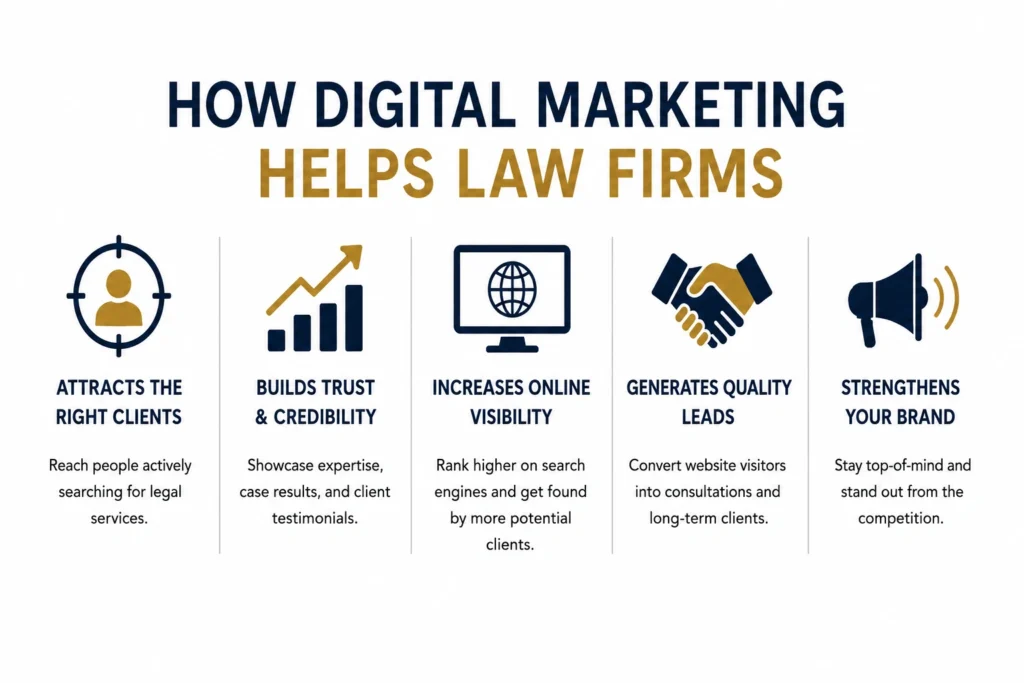
That’s really what this is about. How digital marketing helps law firms isn’t some abstract concept. It’s the difference between showing up when a potential client is actively looking for you, and being completely invisible while a competitor takes that case instead. 96% of people looking for legal services start with a search engine. Not a friend, not a yellow pages ad. Google.
So let’s actually talk about what this looks like in practice.
How Digital Marketing Helps Law Firms Grow Faster
Referrals are fine. Nobody’s telling you to stop asking for them. But relying on referrals as your main pipeline in 2025 is a bit like hoping it rains every time your lawn needs watering. It works sometimes. It’s just not something you can build a plan around.
The importance of digital marketing for law firms shows up most clearly here. Your next client is probably sitting somewhere right now, searching “personal injury attorney near me” or “employment lawyer free consultation.” They don’t know your firm exists yet. A referral can’t help them find you. But a well-built digital presence can.
And here’s the thing a lot of attorneys don’t think about until it’s already a problem. Your competitors are already investing in this. In fact, about 83% of law firms now work with external marketing partners specifically to manage their digital growth. That’s not a trend. That’s most of the market. The firms still relying entirely on referrals are competing against firms with active SEO campaigns, Google Ads running daily, and content strategies that have been building authority for months or years.
It’s worth knowing where you stand relative to that.
Getting Found on Google and What SEO Actually Does for Your Firm
Search engine optimization is probably the channel we talk about most with law firm clients, and honestly, it’s because it tends to produce the highest-quality leads over time. Someone who finds your site through Google because they searched for exactly the service you offer is already a warm lead. They need what you do. They just don’t know you yet.
When someone searches “divorce lawyer in [your city],” Google is making dozens of decisions in milliseconds. Which firms show up, in what order, and whether the map pack at the top of the results includes you. All of that depends on how well your site is built, how much credible content you have, whether your Google Business Profile is complete and active, and how many other reputable sites link back to yours.
For most firms, a strong local SEO foundation starts with a few things most people haven’t fully set up:
- A Google Business Profile that’s actually filled out, with service areas, photos, updated hours, and a stream of real client reviews
- Individual pages for each practice area, not one giant “Services” page that buries everything together
- Consistent business information across legal directories like Avvo, Justia, and FindLaw
- A technically sound website that loads fast on mobile, because that’s where most searches happen
The map pack is worth its own mention. Those three results that appear with the map and star ratings, right at the top of the page, are often the first thing someone clicks. Getting in there consistently requires exactly the kind of local SEO work that a lot of firms have put off. Local SEO can drive up to 400% more visibility for firms that get it right. That’s a real number, and it’s why we prioritize it from day one. Thats how digital marketing helps law firms.
Paid Ads and Leads While Your SEO Is Still Building
Here’s an honest thing to say about SEO: it takes time. Usually four to six months before you start seeing real movement, sometimes longer in competitive markets. That’s not a reason to skip it, the compounding returns are worth the wait. But if you need cases coming in sooner than that, paid advertising fills the gap.
With Google Ads, your firm can appear at the very top of search results, above the organic listings and the map pack, within days of a campaign launching. You pick the exact searches that trigger your ads. Terms like “criminal defense attorney consultation” or “slip and fall lawyer near me” signal that someone is ready to take action, not just researching. That’s who you want to show up for.
Yes, legal is one of the more expensive spaces for paid search. Cost-per-click can be high, especially for personal injury and mass tort keywords. But case values in law are also high, so even a few conversions per month can produce a strong return. The key is pairing those ads with landing pages that are actually built to convert, not just your homepage with a phone number somewhere at the top.
One thing worth knowing: law firms tend to see around a 7% higher conversion rate on PPC compared to most other industries. People searching for attorneys are searching with real intent. They’re not casually browsing.
How Digital Marketing Helps Law Firms Build Credibility Through Content
This section might be the one most firms underestimate, and I think that’s partly because “content marketing” sounds vague when you first hear it.
But think about what your potential clients are actually doing before they pick up the phone. They’re searching. They’re reading. They want to understand what their situation is, what their options are, whether they even have a case. They’re scared, maybe. Or confused. They’re definitely trying to figure out who they can trust.
A law firm that publishes honest, clear content answering those questions, without the usual legal jargon, builds something that ads can’t buy. Trust. The person who found your article on “what to do after a car accident in [state]” and read the whole thing already feels like they know you a little. When they’re ready to call, your firm is the one they think of first.
This is one of the clearest examples of how digital marketing helps law firms in ways that go well beyond visibility. Content is your intake system running 24 hours a day. And it compounds. A blog post written this month can still be generating leads two years from now.
The benefits of digital marketing for law firms in content are also measurable. Firms publishing consistent, useful content typically see organic traffic grow steadily quarter over quarter, which means more searches answered, more trust built, and more consultations booked without spending more on ads.
Reputation, Reviews, and Why People Choose You Over the Next Firm
Something that doesn’t always get brought up in conversations about digital marketing for law firms: your online reputation is marketing. It’s not a separate thing you manage on the side. About 82% of people say a firm’s reputation significantly influences which attorney they contact. That means your Google reviews, how you respond to them, and what people say about you on Avvo and Yelp are part of your pitch.
A firm with 12 reviews at a 4.1 rating and a firm with 78 reviews at a 4.8 rating are not presenting the same case to a potential client. The second firm looks more trustworthy. It looks more established. Even if both are excellent, the one with more positive reviews wins the first impression more often.
Managing this proactively, claiming your profiles, responding to every review, and making it easy for satisfied clients to leave feedback, is part of what we’d call the digital marketing essentials for law firms that tend to get skipped when a firm hasn’t worked with a focused marketing partner before.
Social Media and What It Actually Does for Law Firms
A lot of attorneys hear “social media” and immediately picture dancing videos or promotional posts with stock photos of courtrooms. That’s fair, and that’s also not what actually works for law firms.
LinkedIn is where we tend to start. It builds professional credibility, keeps your firm visible to referral sources, and positions your attorneys as knowledgeable in their areas. Posting regularly, even just twice a week, sharing your take on a recent legal development or a common question clients ask, shows that your firm is active, informed, and worth paying attention to.
Facebook still has real value for community presence, especially for family law, personal injury, and criminal defense practices where the client base is broad. Paid targeting on Facebook lets you reach specific demographics and locations with messaging tailored to their situation.
Neither of these replaces SEO or paid search. But they contribute to the overall picture someone sees when they look your firm up, and that picture matters.
Email and Lead Nurturing, Staying in the Conversation
One thing that surprises firms when they first look at their analytics: a lot of people visit the website and leave without making contact. They’re interested. They’re just not ready yet. Maybe they need to talk it over with a spouse. Maybe they’re still weighing their options. Maybe they filled out a form and then got busy.
Email and simple automated follow-up sequences catch those people. A short series of emails after someone submits a contact form, checking in, sharing a useful resource, offering to answer a question, keeps the conversation alive without being intrusive. Done well, it doesn’t feel like a marketing funnel. It just feels like a firm that actually follows up.
This is an area where a lot of firms are genuinely leaving consultations on the table. The leads are already there. They just need a reason to come back and book.
What DesignFxPro Actually Does for Law Firms
We’ve run campaigns for personal injury firms, employment law practices, family law attorneys, and criminal defense firms. We know how competitive this space is. We also know that a template strategy built for a general small business doesn’t work here.
How digital marketing helps law firms depends entirely on the market, the practice area, the competition, and where the biggest gaps are. What we do at DesignFxPro is start by looking at all of that before recommending anything. We map your local competition, audit your current site and presence, identify what’s costing you visibility, and build a plan specific to your firm’s goals.
You get content that actually sounds like your firm wrote it, campaigns structured around your case types, and reporting that shows you where every dollar is going. No dashboards you can’t interpret, no monthly calls where nothing concrete gets said.
Let’s Figure Out What Your Firm Actually Needs
If you’re reading this and thinking your firm could be doing more online, you’re probably right. And if you’ve tried digital marketing before and didn’t see a return, that’s worth talking through. Usually there’s a fixable reason.
We offer a free strategy consultation with no pressure attached. We look at your current setup, show you what we see, and tell you honestly what we think would move things for you.
How digital marketing helps law firms grow isn’t a mystery. It’s just a matter of building the right things in the right order. Book a free call with DesignFxPro and let’s start there.