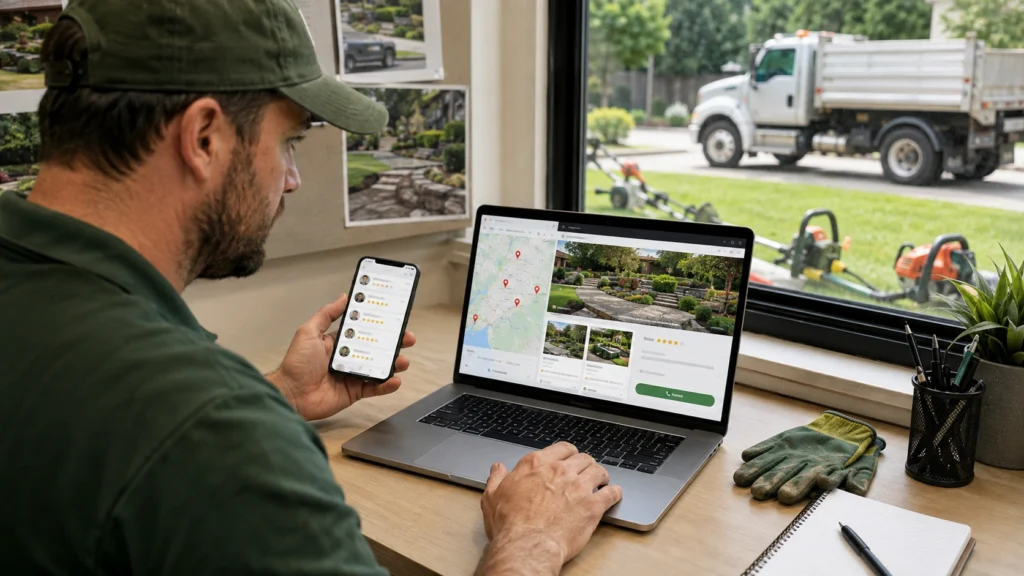
The short answer to how landscapers find clients online is that they show up in local search when someone nearby is ready to hire, prove the work with photos of finished projects, and make it easy to call. Almost everything else is a variation on those three. Property owners searching “landscaper near me” pick from the top three map results, glance at reviews and photos, and dial. If you are not in that view, you are effectively invisible to them.
Here is the part worth sitting with before you spend a dollar. There is a real difference between finding clients and buying them. Most landscaping business owners default to shared lead platforms because they work immediately, then wonder why margins stay thin and the same homeowner keeps comparing four quotes. Companies that shift toward channels they own, their search visibility, their reviews, their site, typically cut cost per lead by 40 to 60 percent. Same number of new customers, considerably more profit per client.
We’ll cover where potential customers actually look, what makes them choose one company over another, how to convert them once they land, and why the clients you already have are the cheapest source of the next ones. These are the proven strategies that hold up season after season, rather than a list of every possible way to get attention.
Where Do Property Owners Actually Look?
They look on Google first, mostly on a phone, and mostly at the map pack. Someone searching “lawn care near me” or “landscaping companies in [city]” is close to hiring, often within days, and rarely scrolls past the first three local results.
This is the single most important thing to understand about how landscapers find clients online. For most landscaping companies, Google search brings in more new clients than every other channel combined, because the intent is so high. Nobody googles “landscaper near me” for entertainment. They have a yard problem and a rough budget, and they are picking someone this week. That is why the map pack matters more than any other placement you can win online. Social media has a role, particularly for design work and building a recognizable brand over time, but it reaches people who were not looking. Search reaches people who already are, and it lets you appear for the specific types of landscaping services you actually want more of rather than whatever landscaping work happens to come your way.
What Makes Someone Choose You Over the Company Next Door?
Proof and recency. Photos of finished work that resembles what they want, a steady stream of recent reviews, and a profile that looks actively maintained. Homeowners decide fast, and they decide visually.
Landscaping is one of the few trades where the buying decision is genuinely aesthetic. Someone can read your copy all day and still not know whether they want your work in their yard. But show them a before-and-after of a patio in a house that looks like theirs, and they know instantly. That is why before-and-after transformations are probably the single most valuable marketing asset a landscaping company owns, and why so few use them properly. Reviews do the other half. A profile with steady, recent feedback reads as a business that is busy and reliable; one with a six-month gap raises a question the homeowner cannot quite articulate but definitely feels. So make it routine to ask for reviews after every completed job, since past customers rarely think to leave one unprompted even when they are delighted. So the pattern is simple. Show the work, keep the reviews current, and look like a company that is clearly operating right now. Much of how landscapers find clients online comes down to removing doubt rather than adding persuasion.
Which Channels Actually Bring In Clients?
The channels that reliably produce are local search and your Google Business Profile, a portfolio-led website, paid search for immediate work, and referrals from existing clients. Everything else supports those.
Here is where I would put the effort, roughly in order of return:
- Your Google Business Profile. The highest-return free action available to a landscaping business. Optimize the basics first: set your primary category to Landscaper, add secondary ones like Lawn Care Service or Landscape Designer, list every city and postcode you serve, and post weekly with photos from recent jobs. Most competitors set this up once and never touch it again, which is your opening. Getting that profile right is the whole of local SEO for a lot of small companies, and it is what puts you in front of someone searching “lawn care near me” tonight.
- Service-area pages on your site. One generic homepage cannot rank across five suburbs. A company with dedicated pages for each city it serves will out-earn one relying on a single homepage, because each page can rank in local search results for its own city. Basic search engine optimization here means writing each page around the keyword a property owner in that suburb would actually type.
- Paid search, used as support rather than a foundation. Google Ads produce work quickly, which is genuinely useful when the schedule is thin, but companies relying on ad campaigns alone see results swing hard month to month. They perform best backed by real SEO visibility.
- Your existing client list. The cheapest source of new work you have. A seasonal check-in, a referral ask after a job that went well, a reminder before cleanup season. Most landscapers never do this systematically, and it costs almost nothing.
Notice that three of those four are things you own outright. That is the difference between building a business and depending on someone else’s platform.
How Landscapers Find Clients Online Without Buying Leads
Shared lead platforms sell the same homeowner to several companies at once, so you compete on price from the first conversation. Companies that move budget toward owned channels usually see cost per lead fall by 40 to 60 percent.
I want to be fair about this, because bought leads are not useless. When you are new, or the calendar has holes, they fill gaps fast. The problem is structural rather than moral. The platform’s incentive is to sell each enquiry to as many contractors as possible, so the homeowner arrives already comparing quotes, the conversation opens on price, and the work lands wherever the platform sends it rather than clustered near your existing stops. Meanwhile nothing you paid for accumulates. Stop paying and the pipeline empties the same week. Every review you gather and every page that ranks keeps producing, which is what makes landscaping client acquisition through owned channels compound instead of reset. The sensible goal is not quitting bought leads tomorrow. It is shrinking them as a share of your pipeline every season while the demand you own grows.
How Do You Convert the Visits You Already Get?
Most landscaping websites lose the majority of their traffic to friction, not competition. Clear service pages, visible project galleries, click-to-call, and an easy quote request convert far better than a homepage that makes people hunt.
Think about what a visitor needs in the first ten seconds: confirmation you cover their area, evidence you do the kind of work they want, and an obvious way to contact you. A surprising number of landscaping sites fail all three. They open with a hero image and a slogan, bury the service list, and hide the phone number in a footer. A few fixes recover most of that lost traffic:
- Match the page to the search. If someone arrived looking for patio installation, send them to a patio page with patio photos, not a homepage covering everything from mowing to snow clearing. Make the services you offer easy to find and easy to tell apart.
- Put the galleries high on the page. Your work is the argument. Make people scroll past finished projects rather than past paragraphs about your commitment to quality.
- Make contacting you effortless. Click-to-call on mobile, a short quote form, and your service area stated plainly. A mobile-friendly site is not optional here, since most of this website traffic arrives on a phone. A person who has just decided they want you should never have to look for the phone number.
- Show the trust signals. Insurance, certifications, and a handful of recent reviews visible without hunting. These answer the question a property owner is too polite to ask.
Fix those four and you will book more jobs from the same traffic you already have.
Fixing this is usually cheaper than buying more traffic, which is why we look at it first when a company says their online landscaping leads are not converting. A big part of how landscapers find clients online is simply not losing the ones who already found you.
What About Content and Staying in Touch?
Publishing helpful content answering local landscaping topics brings in property owners while they are still researching, and email keeps you present with past clients between jobs. Both are slower than ads and cheaper over time.
Content marketing works here for the same reason the map pack does, except earlier in the process. Someone wondering when to aerate, what a retaining wall costs in their area, or which grass suits their climate is not ready to hire yet, but they will be, and the company that answered the question is the one they remember. A post a month on genuine landscaping topics compounds into steady website traffic over a year. Email does the other half of the job. A short seasonal note before cleanup season or a spring reminder to your list is about as cost-effective as marketing gets, and good client communication between visits is often what turns a one-season customer into one of your long-term clients. Neither of these will fill next week’s schedule. Both make the following year easier, which is the trade-off worth understanding before you judge them by the wrong timeframe.
Do Referrals Still Matter When Everything Is Online?
Referrals matter more than ever, they just happen differently now. A neighbor’s recommendation almost always gets verified with a quick search before anyone calls, so your online presence decides whether that referral converts.
This surprises people, but it is consistent with how buying works now. Someone tells their neighbor about the crew that redid their backyard, and the neighbor searches your company name. What they find, your reviews, your photos, your profile, determines whether the referral turns into a call or goes nowhere. So word of mouth and digital presence are not separate systems; the second one finishes what the first starts.
Given that, it is worth making this deliberate rather than accidental. A simple customer referral program turns your current client base into a sales channel that costs almost nothing:
- Give people a reason and a mechanism. Offer existing customers something concrete when they refer a new client, a discount on their next cleanup, a gift card, or a credit toward spring work. Then tell them it exists, because most clients would happily refer you and simply never think to.
- Ask at the right moment. The best time is right after a job the client is visibly happy with, standing in the finished space. Not in a newsletter three months later.
- Make sharing effortless. A short link, a photo of their finished project they can send, a limited-time promotion they can forward to a neighbor. The less work involved, the more referrals arrive.
- Track who sends them. Knowing which satisfied customers refer repeatedly tells you where to focus, and thanking a customer who books you three jobs is the cheapest retention work you will ever do.
Encouraging customers to refer you works best alongside the obvious local marketing that landscapers already have available. Signs at active job sites do real work, since neighbors watching a yard transform are the warmest audience you will ever get. Local partnerships follow the same logic. Real estate agents preparing homes for sale, a nearby nursery, and other local businesses that serve the same property owners without competing with you can all send steady new business, and a reciprocal partnership costs nothing but a conversation. In a trade where one property can pay you for years and introduce you to the street, treating existing clients and your local network as growth channels rather than completed work is how the strongest companies get to find landscaping customers without paying for every single one.
The Mistake That Costs Landscapers the Most Clients
Slow follow-up. A property owner who fills in a form or leaves a voicemail is usually contacting two or three companies the same afternoon, and the one who responds first has an enormous advantage before anyone has quoted a price.
This is the least glamorous fix in marketing and probably the most profitable. You can rank well, run good ads, and take beautiful photos, then lose the job because the enquiry sat in an inbox until Thursday. Landscaping has a particular version of this problem, since owners are often on site all day with their phone in a truck. So the answer is usually process rather than effort: an auto-response acknowledging the enquiry within seconds, a notification that reaches you rather than a shared inbox nobody watches, and a rule that every enquiry gets a real reply the same day. It is worth being honest that this is not a marketing problem at all, strictly speaking. But it is where a lot of marketing spend gets wasted without anyone noticing, and no amount of extra traffic fixes it. If you only change one thing after reading this, change how fast you answer.
Frequently Asked Questions About Finding Landscaping Clients Online
How do landscapers get clients online?
Landscapers get clients mainly through Google, using local search and an active Google Business Profile to appear in the map pack when property owners search. Photos of finished projects and recent reviews then convert those searchers, since most homeowners choose from the top three local results.
What is the cheapest way to get landscaping clients online?
A fully built Google Business Profile is the highest-return free action available, and existing clients are the cheapest source of new work through referrals and seasonal follow-up. Companies moving budget from shared lead platforms to owned channels typically cut cost per lead by 40 to 60 percent.
Are paid lead services worth it for landscapers?
They work as a short-term gap filler but make a weak foundation. Shared leads are sold to several contractors at once, so conversations start on price, and the work often falls outside your efficient service radius. Owned channels cost less over time and keep producing after you stop spending.
How important are photos for landscaping marketing?
Very. Before-and-after project photos are arguably the most powerful marketing asset a landscaping company has, because they let a property owner picture the result on their own property. Landscaping is bought visually, so galleries and recent job photos usually perform better than written descriptions.
How long does it take to start getting clients from search?
Paid search can produce enquiries within weeks, while local search visibility and organic rankings generally take three to six months to mature. Most companies run both, using ads for immediate work while their owned visibility builds toward the busy season.
Ready To Build a Pipeline You Actually Own?
If most of your work arrives through platforms that also sell that same homeowner to three competitors, you are not really building anything. You are paying for access to someone else’s audience, season after season, and it stops the moment you do.
At DesignFxPro, we build the channels landscaping companies own, local search visibility, a portfolio-led site that turns visits into calls, a review engine that runs after every job, and follow-up that turns finished work into next year’s contracts. Our digital marketing work covers your website and social presence as one system, planned against your growing season so the groundwork lands before the surge instead of during it. We help landscaping companies get more landscaping clients without depending on a lead platform for their pipeline, which is usually what growing your landscaping business sustainably actually requires. It is one piece of the bigger picture we cover in our approach to landscape marketing.
Book a free marketing audit with DesignFxPro. We’ll show you where your enquiries are coming from today, what it is costing you, and the fastest path to a pipeline you actually own. Understanding how landscapers find clients online is the easy part; getting your company set up so it keeps working every season, and building a customer base that renews, is the job. The marketing strategies that hold up are rarely the flashy ones.